
The Draw-and-Write Journal: 10 Prompts for People Who Do Not Know What to Say
There is a particular kind of pressure that arrives with a fresh journal page. It looks peaceful, but it can also feel like an invitation to perform: be insightful, be grateful, be honest, and please make it sound beautiful. When you are tired, emotionally full, or simply not in the mood to narrate your life, even “How do I feel?” can feel like an impossible question.
A draw-and-write journal offers another way in. You can begin with a crooked line, a block of color, a rough outline of the mug beside you, or a cluster of shapes that has no obvious meaning. Then you can add a word, a caption, a list, or a sentence. These draw and write journal prompts are designed for that doorway. Each one pairs a simple visual action with a manageable writing invitation, so you never have to fill the whole page at once. Use a pencil, pen, marker, or whatever is already nearby. The goal is not a perfect spread. It is a page that feels possible.
Why drawing can make journaling feel easier
A page can hold more than a polished paragraph
Writing asks you to choose words in a particular order. Drawing can be less linear. A sketch can capture the shape of a day before you know how to summarize it. A dark patch might stand for a crowded schedule; three tiny stars might mark the best part of an otherwise ordinary afternoon. You do not have to decode the image immediately.
That flexibility matters when your thoughts are tangled or when nothing especially dramatic happened. It can be a visual note to your future self: this is what the day felt like and what you want to remember.
The method is expressive
You do not need to be “good at art” or naturally poetic. A draw-and-write journal is successful when it reflects your attention, not when it could be framed. Let imperfect lines lower the stakes. If you want a rule, make it this: your page only needs to be understandable to you today.
How to start without overthinking the spread
Use a three-part rhythm
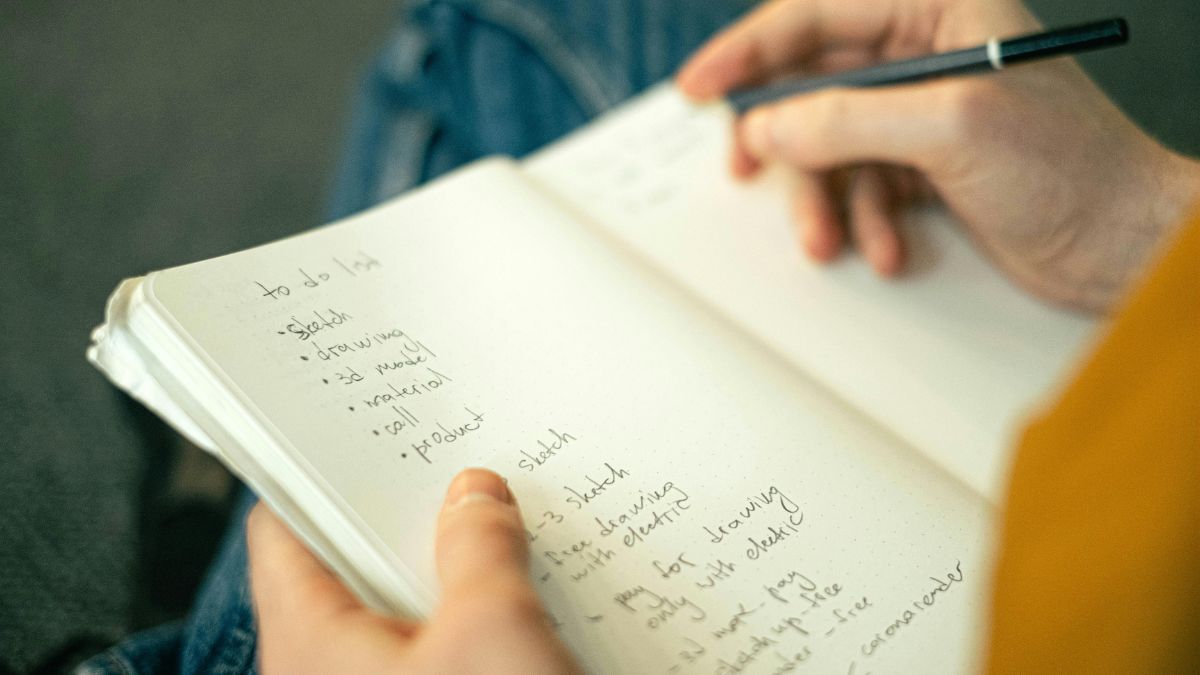
Give yourself five to fifteen minutes and move through three small steps. First, draw for one or two minutes without correcting the image. Second, notice one detail: a color, shape, object, or feeling that appeared. Third, write three to six lines about that detail. You can stop there, or continue if the page has momentum.
This rhythm prevents the drawing from becoming a way to avoid writing forever. It also keeps the writing from taking over before your senses have had a chance to participate. If you are blank, write what you see: “blue loop,” “heavy marks,” “a window,” or “I do not know yet.” That counts as an honest beginning.
Choose a prompt by energy, not by importance
Do not automatically pick the deepest prompt. On a low-energy day, choose an object or a color. On a restless day, choose movement. On a tender day, choose a small act of care. The most useful prompt is the one you can approach without bracing yourself.
For wellness-related reflection, keep the practice gentle. Journaling and drawing may support self-expression, but they are not a substitute for medical, mental-health, or other professional care. If a prompt brings up distress that feels difficult to manage, pause and consider reaching out to a qualified professional or trusted support person.

Prompts 1–3: Begin with what is already around you
Draw the object that has kept you company
Sketch one object you have touched or looked at repeatedly today: a water glass, hair clip, laptop, keys, book, or pair of shoes. Do not worry about perspective. Add three words around the drawing that describe the object’s role in your day.
Then finish this sentence: “I did not expect this ordinary thing to remind me that…” For example, a chipped mug might lead to a note about moving slowly before a difficult meeting. ### 2. Make a weather report for your inner atmosphere
Fill the page with marks that resemble your current inner weather. Use short lines for static, waves for uncertainty, circles for calm, or a single heavy shape for something taking up too much room. You can use actual colors, but black ink works just as well.
Under the drawing, write a forecast in three parts: “Right now,” “What may shift,” and “What I need.” Keep each part to a sentence or a few words. A forecast is allowed to change. You are recording a moment, not making a permanent diagnosis of yourself.
Draw a tiny map of today
Create a map using only five landmarks. They might be a doorway, a message, a meal, a conversation, and the place where you finally sat down. Connect them with a line that shows the route your day took, whether it was orderly, looping, or full of dead ends.
Label each landmark with one word. Then write: “The place I want to return to is…” and “The turn I would take differently is…” ## Prompts 4–7: Give feelings a shape and a voice
Draw the feeling as a room
Imagine your current feeling as an interior space. Sketch the room’s door, light source, furniture, and one detail that does not belong there. It might be a bright chair in a gloomy room or a locked window in a welcoming one.
Write a short room description beginning with “When I enter this feeling, I notice…” End with one practical question: “What would make this room five percent more livable today?” ### 5. Turn a worry into a character
Draw your current worry as a character, creature, cloud, machine, or very serious-looking pigeon. Give it a name and one line of dialogue. Then answer it from your own perspective in a speech bubble or short paragraph.
Try to make the response accurate rather than artificially positive. “I hear that you want certainty, but I only have the next step” is more useful than a slogan you do not believe. The drawing creates a little distance, while the writing lets you respond with steadiness.

Create a before-and-after in two panels
Divide the page in half. In the first panel, draw how a situation looked before you acted, spoke, rested, or made a decision. In the second, draw what changed afterward. The change may be dramatic, or it may be as small as your shoulders lowering after sending an email.
Write one sentence beneath each panel. Finish with: “The part I tend to overlook is…” This prompt trains your attention toward transition. It can reveal effort that disappears when you only judge the final result.
Draw a personal symbol for “enough”
Design a symbol that means enough for you today. It could be a full cup, a closed gate, a small flame, a completed loop, or something entirely abstract. Repeat it three times on the page, changing its size or color each time.
Beside the symbols, write three boundaries that would honor today’s capacity. They could include leaving one task unfinished, declining an unnecessary explanation, or stopping a creative session while it still feels enjoyable. This prompt is especially helpful if your journal has started to feel like another place where you must achieve.
Prompts 8–10: Look forward without forcing a grand plan
Sketch the next kind step
Draw a path with one visible step, not an entire staircase. Add an object beside the step that would help you take it: a charger, calendar, snack, supportive text, clean shirt, or glass of water. Keep the scene concrete.
Write: “The next kind step is…” and “I can make it easier by…” If the step is still too large, redraw it smaller. ### 9. Make a collage of small future pleasures
Fill the page with quick doodles of five things you might enjoy in the next week. They can be sensory and ordinary: warm toast, a favorite playlist, fresh sheets, a walk under trees, a funny voice note, or ten quiet minutes before bed. Write one line beneath each image explaining why it appeals to you. If one item feels realistic to schedule, add a day or time. This is not forced gratitude. It is a reminder that anticipation can be built from details rather than dramatic plans.
Draw a note from your future self, then answer it
Draw a small envelope, postcard, or message bubble. Inside it, write a note from a version of you one month from now. Keep the message specific: what did she stop carrying, notice sooner, protect, or make room for? Avoid making her perfectly transformed.
Now answer the note from where you are today. You might write, “I am not there yet, but I can start by…” Add one small image beside the answer to represent the beginning. The conversation works best when it feels compassionate and believable, not like a lecture from an imaginary life coach.

Common mistakes that make the practice harder
Trying to make every page meaningful
Some pages will be beautiful. Some will be mostly scribbles and half-finished thoughts. That is not evidence that the practice failed. A journal is a record of attention, and attention varies. Let a small page be a small page.
Editing the drawing before you have noticed it
Constant erasing can turn a low-pressure exercise into a design project. Use a pen if you are tempted to perfect every line, or set a timer for two minutes during the drawing phase. The point is to discover what your hand does before your inner editor takes over.
Treating prompts as questions with one correct answer
A prompt can lead to a list, a contradiction, a blank space, or a sentence that says, “Not today.” You can change pronouns, skip a step, or repeat a favorite prompt for a week. ### Buying supplies instead of beginning
A notebook can be inviting, but it is not a prerequisite. Start with a page you already have and one tool. If you later want a more guided format, choose it because it reduces friction, not because you believe it will turn you into a different person overnight.
FAQ: Draw and write journal prompts
What if I cannot draw at all?
Use symbols, lines, blocks, arrows, stick figures, or traced shapes. Drawing here means making marks that help you notice something. You can also write one word inside a shape and decorate the space around it. No artistic skill is required.
How long should a draw-and-write journal session take?
Start with five minutes. A short session gives you a clear stopping point and makes it easier to return tomorrow. If you have more energy, continue for fifteen or twenty minutes. ### Can I use these prompts when I feel emotionally overwhelmed?
You can choose a neutral prompt, such as drawing an object in the room, or stop altogether. Avoid pushing for a breakthrough. If overwhelm is intense, persistent, or connected to safety concerns, journaling is not enough on its own; contact a qualified mental-health professional, emergency service, or trusted person who can help.
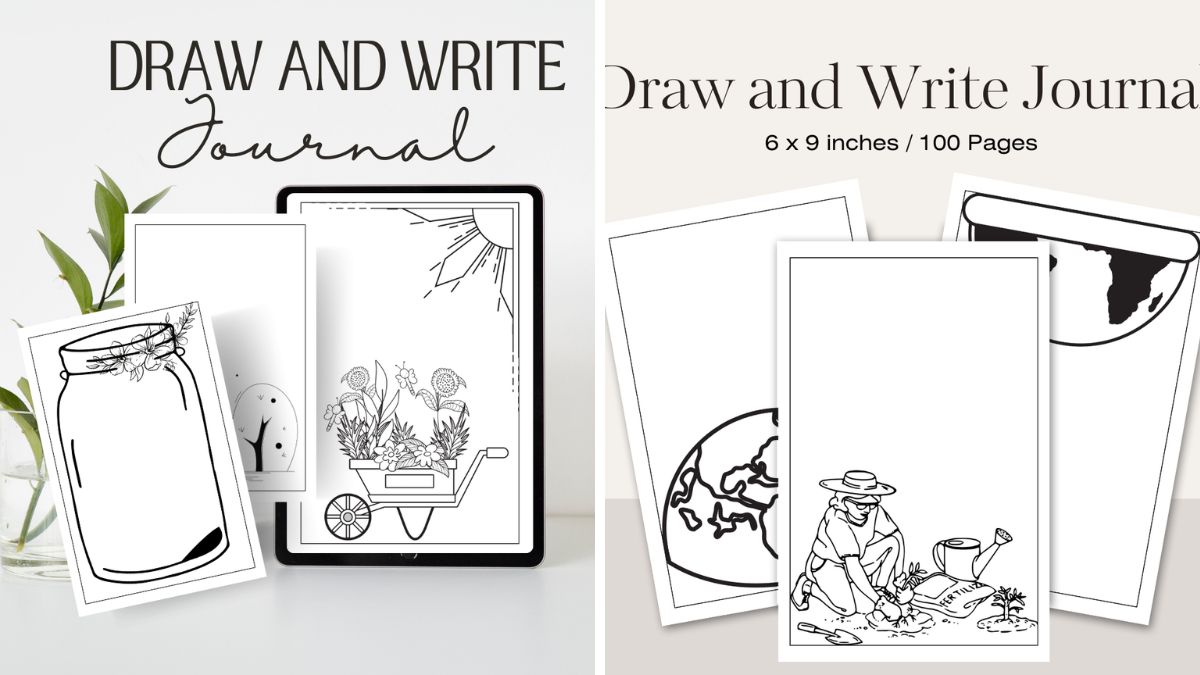
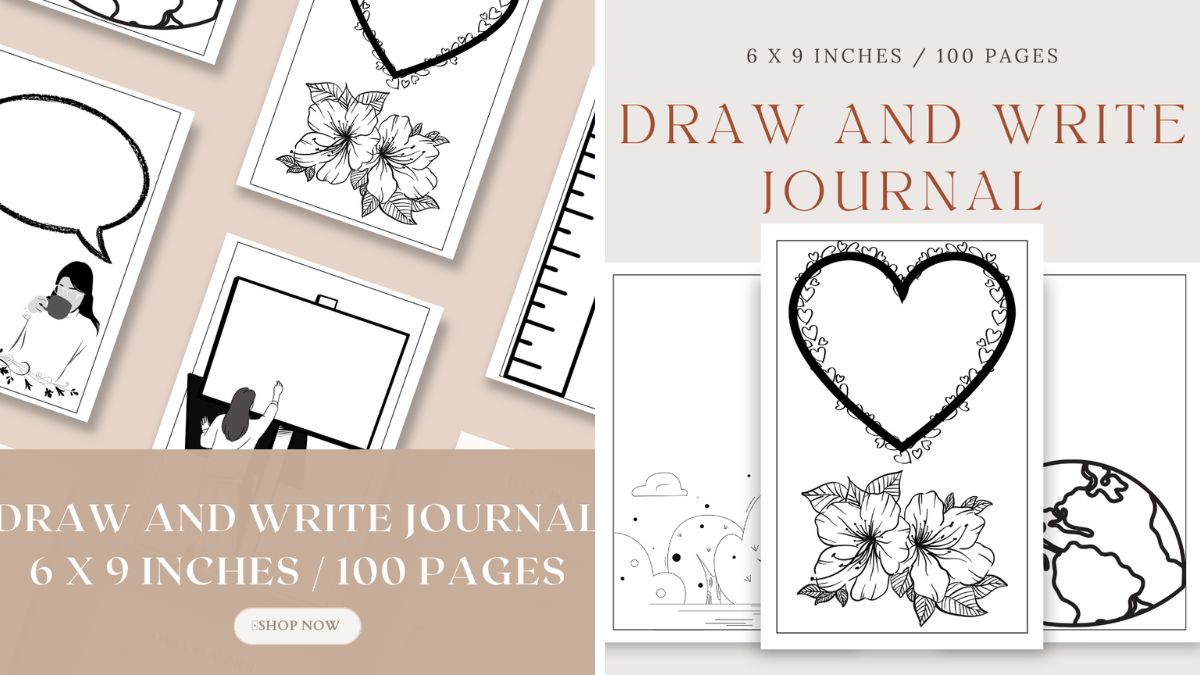
A simple tool can make this practice easier to revisit. The Draw and Write Journal / Editable Canva Template is described on its listing as a journal template for combining writing and illustrations. It is presented as customizable and intended for writers, artists, educators, and anyone who wants to explore words alongside sketches. You can use it as a starting structure for prompts like these, but review the listing itself for the current purchase details before deciding whether it suits your needs.
You do not need a profound sentence to begin. Draw one line, name one color, and let the next honest word arrive when it is ready. Save this list for the next blank-page moment, choose the prompt that feels least intimidating, and make a page that asks nothing of you except your attention.
About the Author