A few years ago, launching a business meant hiring a designer, a copywriter, an assistant, maybe a developer — and writing a very large check. Today, a single person with a laptop, a clear idea, and the right tools can do the work of a small team.
That’s the quiet revolution happening right now, and it’s why so many women are choosing to start a business with AI instead of waiting for the “perfect” moment, budget, or co-founder.
But there’s a catch: AI isn’t magic, and “just use ChatGPT-style tools” is not a business plan. This guide breaks down what AI is genuinely good at, where humans still win, and how to build a lean, one-person business that doesn’t burn you out.
What Is an AI Solopreneur?
A solopreneur runs a business alone. An AI solopreneur uses artificial intelligence as a force multiplier — a tireless assistant for drafting, researching, organizing, and brainstorming.
Notice the key word: assistant. The most successful AI-powered founders don’t hand over the wheel. They use AI to handle the 70% that’s repetitive so they can focus on the 30% only they can do: strategy, relationships, taste, and judgment.
Think of AI as an extremely fast, occasionally overconfident intern. Brilliant at first drafts. Needs direction. Requires a human editor.

What AI Can (and Can’t) Do for Your Business
Where AI Shines
- Brainstorming: business ideas, product names, content angles, offer variations
- First drafts: emails, blog outlines, product descriptions, social captions
- Research summaries: turning long articles or notes into digestible takeaways
- Organization: meeting notes, to-do lists, SOPs, content calendars
- Customer communication: drafting replies to common questions
- Repurposing: turning one idea into a blog post, newsletter, and five social posts
Where You Still Need to Lead
- Your unique point of view and story
- Fact-checking — AI can sound confident while being wrong
- Brand voice and taste
- Ethical and legal decisions
- Real relationships with customers and collaborators
The rule of thumb: let AI draft, you decide.
Step 1: Choose a Business Model That Fits a Team of One
Not every business suits a solo operator. Lean models work best:
- Service businesses: freelancing, consulting, virtual assistance, coaching
- Digital products: ebooks, templates, courses, printables
- Content businesses: blogs, newsletters, YouTube, podcasts
- Hybrid models: a service plus a digital product to create multiple income streams
Choose based on three things: your skills, your interests, and a real problem people already pay to solve. Idea validation matters more than idea originality.

Step 2: Validate Your Idea Before You Build Anything
AI makes building fast, which makes it dangerously easy to build the wrong thing. Validate first:
- Describe your idea in one sentence. “I help [specific person] achieve [specific result].”
- Look for demand. Are people searching for this? Asking about it in forums and groups? Already paying competitors?
- Talk to five real people. Short conversations will teach you more than a month of guessing.
- Pre-sell or test. Offer a small version before creating the whole thing.
Use AI to speed up the research — summarizing competitor offers, generating interview questions, spotting patterns in feedback — but keep the conversations human.
Step 3: Build Your AI-Powered Workflow
This is where the magic happens. Instead of using AI randomly, design a repeatable system.
A simple weekly workflow might look like this:
- Monday – Plan: Use AI to organize priorities and break big goals into tasks
- Tuesday – Create: Draft content, product copy, or client deliverables with AI support, then edit heavily
- Wednesday – Connect: Handle emails, outreach, and customer questions (with AI drafting replies you personalize)
- Thursday – Improve: Review what worked, update templates, refine your prompts
- Friday – Wrap and rest: Automate, batch, and close the loop
The golden habit: save your best prompts and templates. A strong, reusable prompt library is like hiring and training an assistant once, then using them forever.

Step 4: Write Better Prompts (The Skill Everyone Underestimates)
The quality of what you get from AI depends on the quality of what you ask. Vague in, vague out.
A strong prompt usually includes:
- Role: “Act as an experienced email marketer for a wellness brand.”
- Context: who your audience is and what you’re offering
- Task: exactly what you want created
- Format: length, structure, tone
- Constraints: what to avoid, what to include
Weak: “Write an email about my coaching.” Better: “Write a warm, 150-word welcome email for new subscribers to my career coaching newsletter. Audience: women in their late 20s feeling stuck at work. Tone: encouraging, direct, no jargon. End with a question inviting a reply.”
Then iterate. Great results usually come from the second or third round, not the first.
Step 5: Set Up Your Business Foundations
Even a tiny business needs a few basics:
- A simple brand: name, color palette, and a clear one-line promise
- A home base: a basic website or landing page
- A way to get paid: secure payment tools
- An email list: the one audience you actually own
- Basic legal and tax awareness: requirements vary by country, so check local rules or consult a professional
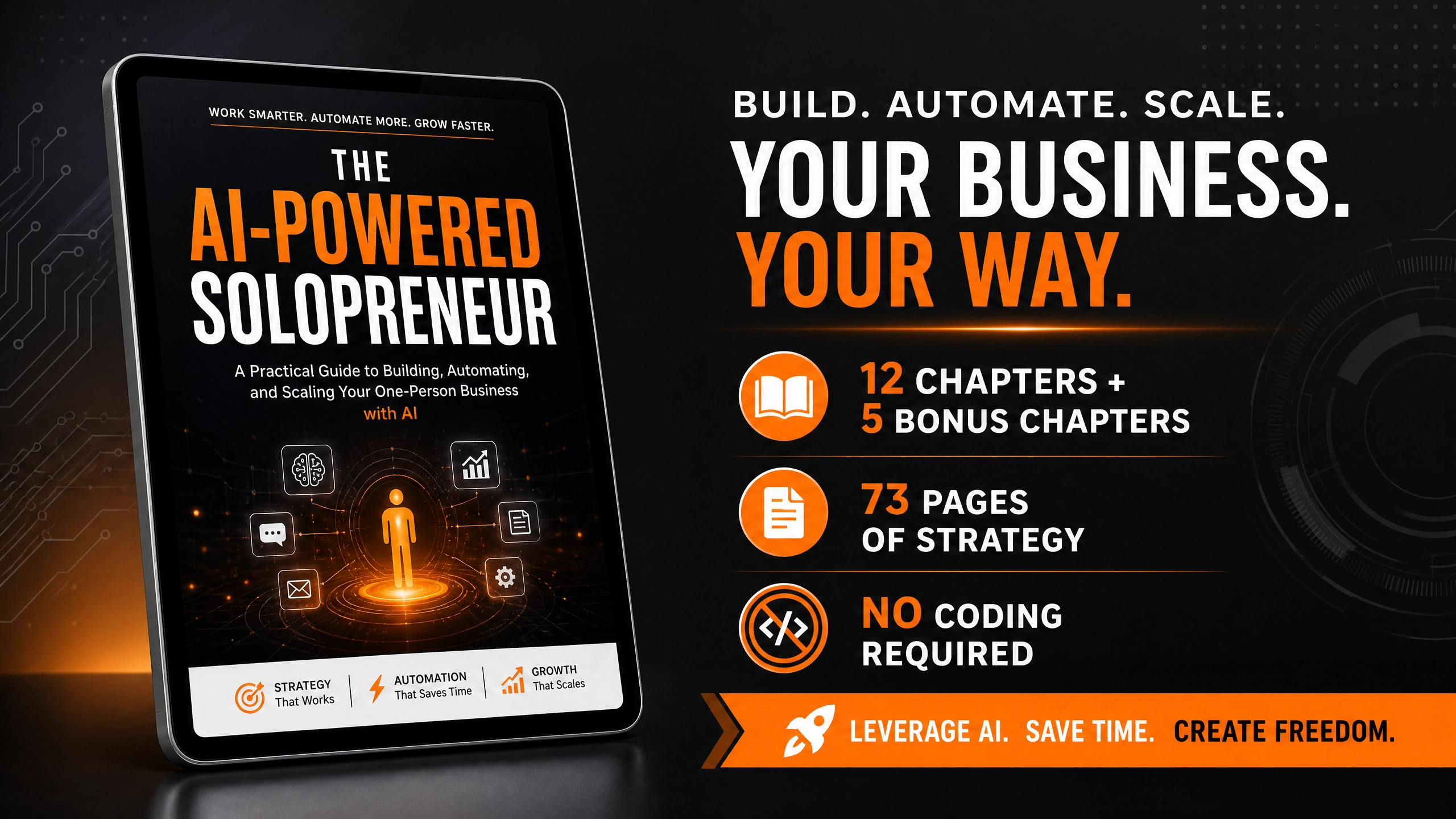
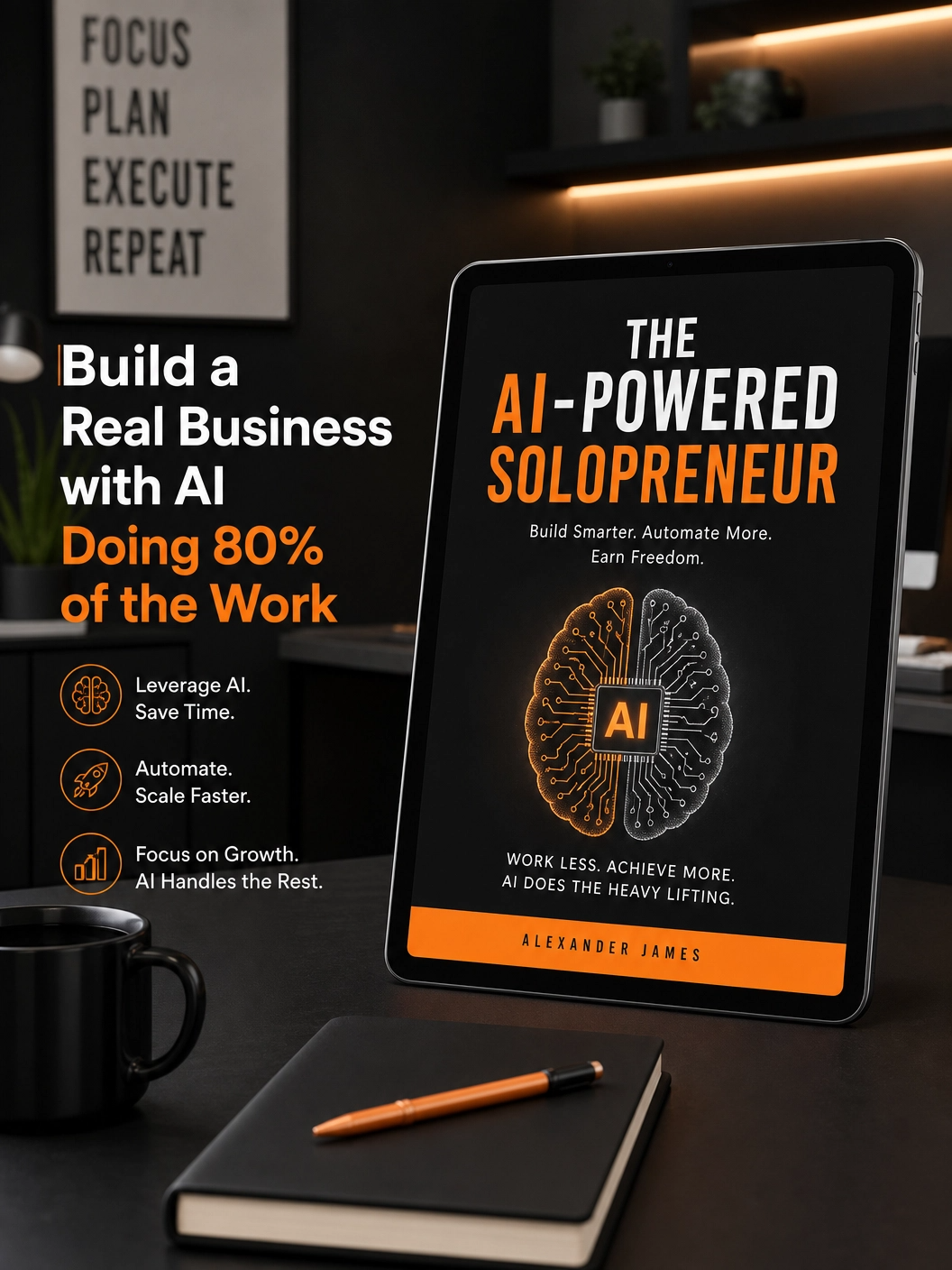
If you want a complete walkthrough of building a business around AI — including the mindset, systems, and strategy — The AI-Powered Solopreneur is designed to take you from idea to a working, lean business without needing a tech background.
→ Shop it: The AI-Powered Solopreneur
Step 6: Protect Your Time and Energy
One-person businesses fail from burnout more often than from bad ideas. AI can help you work smarter, but only if you set boundaries.
- Set working hours and stick to them
- Automate repetitive tasks (scheduling, reminders, templates)
- Batch similar work to avoid constant context-switching
- Take real breaks — creativity needs rest
- Say no to opportunities that don’t fit your goals
The goal isn’t to do more. It’s to build a business that fits your life.
Common AI Business Mistakes to Avoid
Publishing raw AI output. Readers can feel generic writing. Always edit, add your stories, and inject your voice.
Skipping fact-checks. Verify statistics, quotes, and claims before sharing.
Chasing every new tool. Master two or three tools before adding more.
Ignoring privacy. Avoid pasting sensitive client or personal data into tools without understanding their data policies.
Expecting overnight results. AI speeds up the work; it doesn’t shortcut trust, which still takes time.
5 Low-Cost Business Ideas to Start With AI
- AI-assisted content services — blog and newsletter writing for small businesses
- Digital templates and planners — designed, described, and marketed with AI help
- Social media management — content calendars and captions, refined by your strategy
- Niche newsletters — curated insights for a specific audience
- Consulting for small businesses — helping others adopt AI tools for admin and marketing
Each can start small, with minimal investment, and grow as you learn what your audience wants.
A Day in the Life of an AI-Powered Solopreneur
What does this actually look like? Here’s a sample day for someone running a small content and digital-product business with AI support (your version will look different, and that’s the point):
Morning (90 minutes of focused creation). She starts with the work only she can do: outlining a new guide based on questions her audience keeps asking. Then she asks her AI assistant to propose a structure, suggest examples, and flag gaps. She edits the outline, rewrites the intro in her own voice, and adds a personal story.
Midday (admin power hour). Customer emails get quick, friendly replies, drafted with AI help and personalized before sending. Social captions for the week are batched. Her to-do list is reorganized into three priorities.
Afternoon (strategy and learning). She reviews what’s selling, uses AI to summarize feedback from customers, and decides what to create next.
Evening (off). Laptop closed. The business doesn’t need her at midnight.
Notice the pattern: AI handles the speed parts, and she handles the soul parts. That balance is what makes a solo business sustainable — and enjoyable.
FAQ: Starting a Business With AI
Do I need technical skills? No. If you can write a clear email, you can learn to use AI tools well.
Is it expensive? Many tools offer free tiers, and a lean setup can cost very little. Add paid tools only when they solve a real bottleneck.
Will AI replace my business? AI changes how work gets done, but trust, creativity, and relationships remain human advantages — and those are what customers return for.
How long until I see results? It depends on your model and consistency. Plan on months of steady effort, not days.

Your Lean Launch Starts Now
You don’t need investors, employees, or a big launch party. You need a clear problem to solve, a few smart tools, and the willingness to start before you feel ready.
Pick one idea this week. Validate it with five conversations. Build the smallest version. Then let AI handle the busywork while you handle the brilliance.
Save this guide, share it with the friend who’s always “thinking about starting something,” and take the first small step today.
About the Author