The Ultimate Rainy-Day Activity Guide for Families Who Are Tired of Screens
Rain can make a family day feel compressed: everyone is home, errands are postponed, and “I’m bored” arrives before lunch. The quickest answer is often a device, even when parents want a different rhythm.
A screen-free afternoon does not require a craft room or a perfect supply closet. It needs a few activities with a clear beginning, a useful job for each person, and room for different ages. The best rainy day activities for families offer something concrete without demanding constant entertainment.
Use this guide as a menu. Choose one active idea, one making idea, and one quieter finish. Let each person adjust the same activity to suit their age and energy.
A sudden “no screens today” announcement can make a rainy day feel like a punishment. Instead, explain the plan in practical terms: the family is going to try a different kind of afternoon, and devices will be parked until a chosen check-in time. Put phones on a charger in a hallway or kitchen rather than leaving them faceup on the table.
Then hold a five-minute family huddle. Ask three questions: What sounds active? What would you like to make? What snack should we prepare? Write the answers on a scrap of paper. Children are more likely to participate when they can see their preferences reflected in the plan, and adults avoid having to invent entertainment every 20 minutes.
Build a rainy-day basket.
Keep a small basket in an accessible cupboard with blank paper, washable markers, crayons, tape, child-safe scissors, string, a deck of cards, dice, and a few envelopes. Add a flashlight, a measuring tape, and a timer if you have them. These ordinary objects turn a vague afternoon into an invitation.
Keep the basket small. A limited selection creates momentum and makes cleanup possible, while familiar supplies mean the family can begin without a shopping trip.
Turn the living room into an indoor field trip
An indoor field trip is about looking at familiar things with a new question. Choose a theme such as how homes stay warm, the history of a family object, or animals near your neighborhood.
Start with a “museum walk.” Each person selects one household object and writes or dictates a three-sentence label for it: what it is, where it came from, and why it matters. Arrange the objects on a shelf or table. One child can be the curator, another can make admission tickets, and an adult can ask the questions a visitor might ask.

Add a clue trail
Write five simple clues that lead from one room to the next. The final clue can point to a snack, a book, or the materials for the next activity. For younger children, use drawings or colors instead of written riddles. For older children, add a measurement challenge, such as finding three objects longer than a hand or locating something that starts with a particular letter.
The goal is not to create an elaborate treasure hunt. Keep the clues visible enough that frustration does not take over. A successful trail should make children notice their surroundings, cooperate, and move around the house with purpose.
Cook a tiny café together
Cooking gives the afternoon a satisfying arc: choose, prepare, serve, and clean up. Pick one adaptable menu, such as a baked potato bar, toast tasting, mini pizzas, fruit skewers, or soup with toppings.
Give every person a real role. One child can wash produce, another can measure, and an older child can read the recipe aloud or set a timer with supervision. Adults should handle hot pans, sharp knives, and any task that requires judgment about food safety. Let children make small choices, such as naming the café, designing a menu, or deciding how to arrange the toppings.
Make the meal feel special without making it precious
Use a tablecloth, a pitcher of water, or the nicer glasses you usually save for guests. Ask everyone to create one menu description, but avoid turning the meal into a performance. “Cinnamon apple toast with a dramatic crunch” is enough. The point is to make an ordinary snack feel intentional.
Set a short cleanup rule before you begin: the café closes when the counters are wiped and dishes are in the sink or dishwasher. This keeps the activity from becoming an adult-only mess. Children can return tools, stack unbreakable dishes, and sweep crumbs with help.
Let the table become a shared art studio
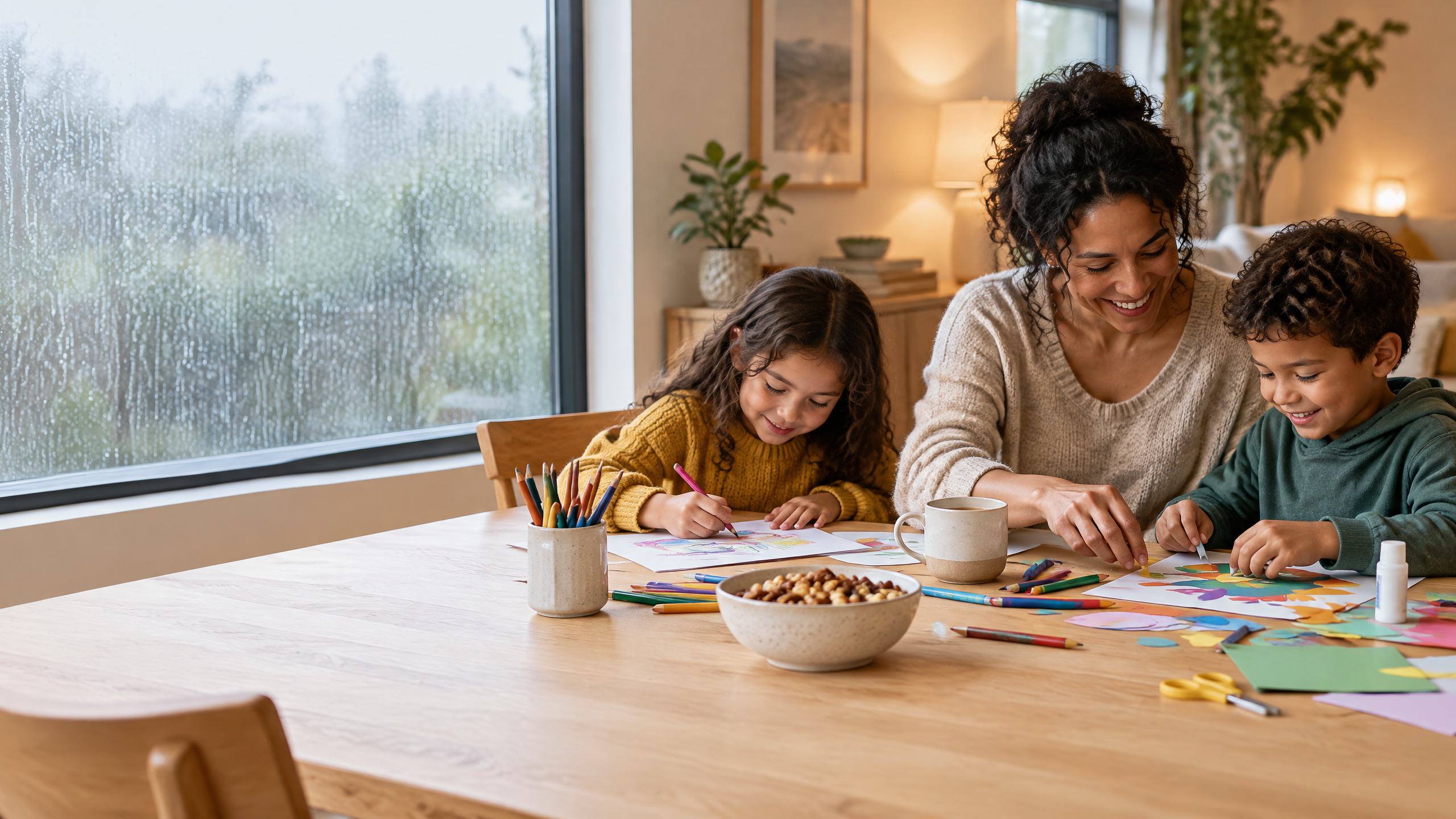
Art is easier to start when it has a shared destination. Create a paper neighborhood, an imaginary garden, a family flag, or a weather journal with one page for each hour of rain.
For a mixed-age group, offer several ways to contribute. One person can draw, another can cut shapes, another can write labels, and a younger child can choose colors or add patterns. If someone does not want to collaborate, give that person a defined side panel that will still connect to the larger project.
A low-prep coloring option for the quiet stretch

When attention starts to dip, coloring can provide a calm bridge between louder activities. The Adorable Dog Coloring Pages / Sheets of Adorable Dog Clipart {Coloring Book} is a coloring-pages product from the linked listing. It can be a straightforward option for a family art table when you want a ready-made subject instead of drawing prompts.

Use it transparently: review the listing yourself before buying, and choose coloring tools that suit the children in your home. Place the pages on a shared table with crayons or pencils, then invite everyone to add a different setting, pattern, or “dog personality” if they want to extend the activity. Nobody needs to finish a page, match a color scheme, or produce something display-worthy. This is a creative pause, not a test.
Build a movement circuit that does not feel like exercise
Indoor movement works best with a story. Call the hallway a runway or sofa cushions stepping stones, but clear breakable objects first and keep jumping away from furniture edges, stairs, and slippery rugs.
Create four stations with household items: balance along a strip of painter’s tape, toss rolled socks into a laundry basket, crawl under a table, and hold a wall sit while another person counts slowly. Let each family member invent one station, then rotate every two minutes. A timer can help, but an adult can also call “switch” to keep the mood relaxed.
Offer quiet movement too
Not every child wants a high-energy game, and adults may be tired. Add options such as animal walks, a stretching story, a slow balloon tap, or a balance challenge while holding a stuffed animal. If someone is recovering from illness, has a disability, or simply does not feel up to moving, give them a role as the announcer, scorekeeper, or photographer only if they want one. Participation should not depend on athletic ability.
Any movement suggestion here is general lifestyle guidance, not medical advice. Stop if someone feels pain, dizziness, or unwell, and adapt activities to your household’s needs.
Make room for unhurried play and conversation
After making, cooking, and moving, shift to a lower gear. Try a cooperative puzzle, a one-sentence-at-a-time story, household-object charades, or a question jar with prompts such as “What would you put in a houseboat?”
For a calmer variation, spread blankets on the floor and create a reading nest. Each person chooses a book, comic, magazine, or printed recipe. Read independently for 15 minutes, then invite anyone who wants to share a favorite detail. Quiet does not have to mean total silence; it means the household is no longer rushing toward the next stimulation.
Keep competition optional
A family game can become tense when one person always wins or when rules are too complicated. Before starting, decide whether the goal is to cooperate, practice a skill, or simply laugh. Games with teams, rotating roles, or no score at all are often easier for mixed ages. If a child becomes upset, pause and change the format instead of insisting that everyone finish.
Finish with a plan you can repeat
The most useful rainy day activities for families are repeatable. Before dinner, ask what each person would keep and change, then record the best ideas in a “Next Rain” notebook. Make entries specific: “draw a neighborhood map with three bridges” is easier to start than “art.”
Common mistakes that make screen-free days harder
The first mistake is trying to fill every minute. A family needs transitions, snacks, bathroom breaks, and time for an activity to become interesting. Leave white space between ideas.
The second is choosing projects that create more adult labor than family connection. If the setup takes an hour and the children participate for ten minutes, simplify it next time. Use fewer materials and a shorter finish line.
The third is treating boredom as an emergency. A few quiet minutes may be the doorway to imaginative play. Offer two choices, then give children time to begin. You can stay nearby without directing every move.
The fourth is expecting everyone to want the same thing. A rainy-day plan can have a shared start and separate endings. One child may color while another reads, as long as the house has agreed on the boundaries and cleanup.

FAQ: Rainy-day activities for families
What are good rainy day activities for families with different ages?
Choose activities with multiple roles rather than one fixed outcome. A café can include washing, measuring, menu design, serving, and cleanup. A clue trail can use pictures for younger children and riddles or measurement challenges for older ones. Everyone joins the same project at an appropriate level.
How do we keep children from asking for screens all afternoon?
Set a clear start and end time for the screen-free block, then make the next activity visible. Put the basket on the table, write the first two choices on paper, and join for the opening few minutes. If devices remain available, keep them in a shared charging spot so the boundary is easy to understand and follow.
What if my family does not enjoy crafts?
Skip crafts. Try cooking, indoor exploration, movement, music without a screen, a read-aloud, or reorganizing a small space into a pretend shop. The purpose is shared attention, not a particular category of activity. Choose something with a concrete job and a natural stopping point.
Make the next rainy day easier.
You do not need to become a full-time activity director. Put a few reliable supplies together, choose one project with real household roles, and protect a quiet ending. Save this guide, start a rainy-day basket, and ask your family to choose one idea before the next forecast.
About the Author