
Future-Self Journaling Without the Cringe: A Grounded Guide to Becoming More Intentional
There is a version of future-self journaling that feels a little too polished: the imaginary woman who wakes before sunrise, drinks green juice, answers every email calmly, and somehow has a linen closet worthy of a design magazine. If that picture makes you want to close your notebook, you may simply need a more believable definition of your future self.
A future self is not a fantasy character or a personality upgrade you earn by becoming perfectly disciplined. She is you with a clearer relationship to your values, attention, time, and energy. Journaling can help you notice what you want to protect and which small decisions make your days feel more like your own.
The point is not to manifest a flawless life on paper. It is to create a useful conversation between who you are today and who you are practicing becoming. Below are practical prompts, a simple method, and guardrails that keep the process honest.
Start with a future self you can actually recognize
Before writing a goal, take the pressure off “best self.” It often smuggles in someone else’s definition of success: more money, a smaller body, a busier calendar, or endless positivity. A grounded future self is not necessarily more impressive. She is more intentional.
Trade the highlight reel for ordinary details
Instead of picturing a dramatic “after” photo, imagine a regular Tuesday six or twelve months from now. Where does your attention go in the first hour? What does your home feel like at the end of the day? How do you speak to yourself when you miss a target? Which commitments have become easier to decline?
Specific details make a vision actionable. “I am thriving” is difficult to use; “I leave ten quiet minutes between work and dinner” gives you something to test.
Separate values from aesthetics
A beautiful desk, a certain wardrobe, or a morning routine can be enjoyable, but they are not automatically values. Ask what the image represents. A tidy desk might stand for focus. A polished outfit might stand for self-respect or creative expression. Early bedtime might represent steadiness rather than productivity.
Naming the underlying value helps you avoid mistaking an internet aesthetic for a life plan.

Use future self journaling prompts that lead to choices
The best prompts move you from a broad desire to an observable decision. Choose two or three rather than answering every question in one sitting.
Prompts for clarity
- What do I want more room for in an average week, and what currently takes that room?
- Which part of my life feels quietly out of alignment, even if it looks fine from the outside?
- What am I saying yes to mainly because I am afraid of disappointing someone?
- If I could keep only three priorities for this season, what would they be?
- What would “enough” look like for me this month?
Prompts for identity without the performance
- What does my future self do when she is tired, not just when she is motivated?
- Which quality am I practicing: patience, courage, discernment, playfulness, or something else?
- What is one promise I can keep to myself without needing an impressive transformation?
- How would I make this decision if I trusted that consistency can be quiet?
- What would I stop explaining if I felt secure in my own priorities?
Prompts for practical change
- What is one recurring friction point I could make easier with preparation?
- Which habit would support my future self, and what is the smallest version of it?
- What boundary would create more time, money, rest, or emotional space?
- What evidence would tell me that this change is helping?
- What can I do in the next 15 minutes that my future self would genuinely appreciate?
These questions ask for experiments, boundaries, and evidence—not a promise to become a different person by Monday.
Turn the vision into a small weekly practice
A journal can become another place where you collect intentions without acting. Use a short review that connects the page to your calendar: imagine, choose, try, notice, and adjust.
Step 1: Write a believable snapshot
Set a timer for ten minutes. Write in the present tense about an ordinary day in the life you are building. Include a difficult email, an unplanned expense, a low-energy evening, or a change of plans. These moments reveal more than idealized vacations and achievements.
For example: “I am not available for every request. I check my schedule before answering. When I lose momentum, I restart with one small task instead of calling the whole week a failure.”
Step 2: Circle the behaviors hiding inside the story
Look for verbs, not just outcomes. “I feel peaceful” might contain behaviors such as putting the phone away during meals, asking for help sooner, or leaving a buffer before appointments. Select one behavior that is both meaningful and realistic.
A useful test is whether you could do it on a difficult day. If not, shrink it. “Exercise every morning” might become “put on walking shoes after lunch twice this week.” “Be less anxious about money” might become “review upcoming bills for 15 minutes on Friday.”
Step 3: Put the experiment somewhere visible
Give the behavior a time, place, and cue. “I will journal more” is a wish; “After I brush my teeth on Sunday, I will answer one prompt for eight minutes” is a plan. Use a notebook, notes app, or calendar reminder—the format you will return to without resentment.
Step 4: Review without grading yourself
At week’s end, ask: What felt supportive? What created friction? What is the next smallest adjustment? The review is information gathering. A missed habit may point to an unrealistic time, unclear cue, or need for rest—not a defective character.

Make future-self journaling honest about money, energy, and care
Intentional living becomes more useful when it includes constraints. A future self who ignores your budget, health, responsibilities, or access to support is not a motivating vision; she is another source of pressure.
Let the plan fit your actual capacity
Ask, “What can I sustain in this season?” A plan for a demanding work month will look different from a plan for a quiet month. If your energy is low, focus on reducing friction: prepare a simple breakfast, ask someone to share a task, or protect a consistent bedtime. Do not turn every limit into a mindset challenge.
Wellness journaling can support reflection, but it is not medical care. If fatigue, anxiety, disordered eating, sleep problems, or other symptoms are persistent or distressing, speak with a qualified healthcare professional rather than using prompts as a substitute for evaluation or treatment.
Include support, not just self-discipline
Write questions such as: “Who could make this easier?” and “What conversation have I postponed?” Your future self may be better at receiving help, negotiating a deadline, or asking a partner to share invisible labor. Independence is not the same as doing everything alone.
Keep nutrition and movement neutral
If food or exercise appears in your vision, describe them in terms of nourishment, strength, enjoyment, or energy rather than punishment or moral worth. Individual needs vary, and nutrition advice should be personalized with a registered dietitian or healthcare professional when appropriate. A journal should expand your choices, not make your body another project to manage.
A five-minute template for busy days
You do not need an elaborate ritual. On a crowded day, use this compact entry:
Today I want to remember: one fact, feeling, or lesson from the day.
The woman I am practicing becoming would value: one quality or priority.
One choice that supports it is: a specific action that takes 15 minutes or less.
A kinder interpretation of today is: a sentence that replaces all-or-nothing thinking with context.
Tomorrow’s first useful step: the next action, not the entire plan.
Here is a filled-in example:
Today I want to remember that I felt resentful after agreeing to a last-minute favor. The woman I am practicing becoming values generosity with boundaries. One choice that supports it is asking for a day to check my schedule before saying yes. A kinder interpretation of today is that I noticed a pattern early. Tomorrow’s first useful step is drafting a short, respectful response.
This format holds ambition and reality together without asking your present self to pretend everything is easy.

Common mistakes that make the practice feel forced
Writing as if your future self has no problems
A satisfying vision still includes uncertainty, conflict, chores, and imperfect weeks. Include the skills you want to use when life is difficult. Resilience is having a way to return to what matters.
Borrowing goals you do not want
If a goal sounds impressive but makes you feel heavy, investigate it. Is it yours, or did you absorb it from family, social media, workplace culture, or a fear of being judged? You can revise a goal without making a public announcement.
Confusing journaling with decision-making
Insight does not automatically change a relationship, budget, schedule, or habit. After writing, ask, “What decision is this asking me to make?” If there is none, let the entry be reflection; otherwise, make the next step concrete.
Using the journal to criticize your present self
Your current self is not an obstacle blocking the arrival of a better woman. She carries the information, responsibilities, and needs that your future plans must respect. Write as you would to a close friend who is trying.
Treating prompts as a test of consistency
Missing a day does not erase the value of the practice. Return when you can. A journal is for reorientation, not proof that you deserve your goals.
A simple way to keep going
Choose one monthly theme: boundaries, creative time, money clarity, rest, friendship, or confidence. Each week, answer one prompt, choose one experiment, and record evidence. At month’s end, ask which actions gave you energy, which goals mattered less, and what support you need next.
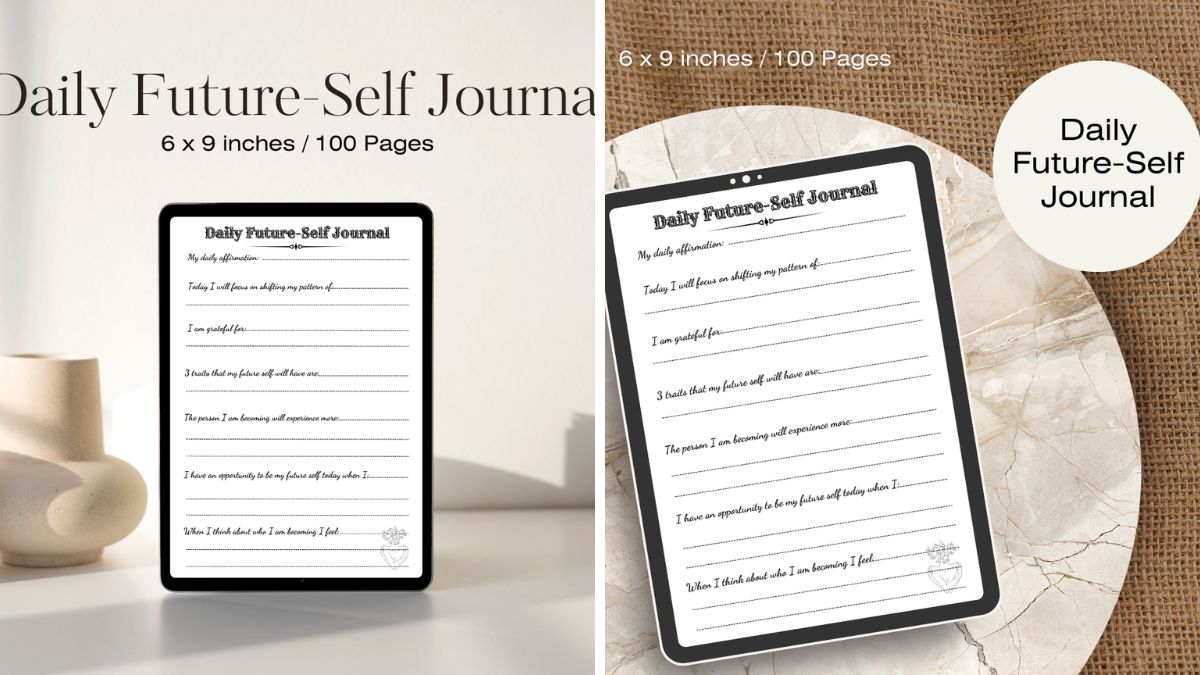
If you prefer a guided starting point, the Daily Future-Self Journal / Editable Canva Template is described by its listing as a customizable Canva template for goals, intentions, reflection, and self-awareness. The listing states that the purchase includes one PDF with a Canva link and notes 100 pages in Canva. It may suit anyone who wants an existing structure to personalize. Review the product page for current details; it is a journaling aid, not a guarantee of outcomes.

FAQ: Future-self journaling prompts
How often should I do future-self journaling?
Once a week is enough to begin. A brief daily entry can work, but frequency matters less than returning with attention. Start with ten minutes on a reliably protected day, then adjust.
What if I do not know what my future self wants?
Start with what you want less of: rushing, financial vagueness, one-sided relationships, cluttered commitments, or harsh self-talk. Then ask what would create space. Clarity often arrives through small experiments.
Can future-self journaling replace therapy or professional advice?
No. Journaling can help you organize thoughts and notice patterns, but it cannot diagnose or treat mental-health, medical, nutrition, or relationship concerns. For persistent distress or high-stakes decisions, seek support from an appropriately qualified professional.
Your next page can be small
You do not need a complete life blueprint to become more intentional. You need a believable direction, one choice that fits real life, and self-respect to revise the plan when circumstances change. Open a notebook tonight and answer this: What would my future self thank me for making easier this week? Then choose the smallest honest action and put it on the calendar. That is not cringe. It is practice.
About the Author