
The 10-Minute Journal Habit: A Tiny Reflection Practice That Actually Fits Real Life
Somewhere between the ideal morning routine and the actual morning rush, journaling often gets abandoned. The notebook sits on the nightstand while you answer messages, find a missing shoe, make coffee, or open your laptop “for just one thing.” By evening, reflection sounds lovely in theory and impossible in practice.
A 10 minute journal practice offers a more realistic alternative. It is not a promise that ten minutes will solve every worry. It is a small appointment with your own attention. In that time, you can name what is taking up space, notice one good thing, and decide what deserves your energy next. That is enough.
The goal is not to produce beautiful pages or uncover a life-changing insight every day. The goal is to make checking in with yourself easy enough to repeat. Here is how to build a version that works around work, caregiving, low energy, changing schedules, and the ordinary mess of being a person.
Why ten minutes is enough to begin
Reflection works better when it has a clear edge
“Journal more” is a vague instruction. Ten minutes is specific. A defined start and finish lowers the pressure to write something impressive, while a short window makes it easier to protect the habit on a busy day. You are not signing up for a second job. You are creating a small container.
The time limit also keeps reflection from becoming an endless replay of every conversation, decision, and possible future problem. You can write honestly, then return to the day. If a concern needs more attention, you can give it a note for later rather than allowing it to take over the entire session.
Consistency matters more than intensity
A journal is useful when it helps you notice patterns over time. A short entry you can return to is often more practical than a rare, dramatic writing session. Think of the practice as a check-in, not a performance review.
Some entries may be thoughtful. Others may be three sentences and a grocery reminder. Both count. The habit becomes sustainable when it can include your ordinary days, not only the days when you feel inspired.

Set up a practice that fits your real life
Choose an anchor, not an ideal
Attach journaling to something you already do: after your first drink in the morning, when your child starts a quiet activity, after closing your workday, or while the kettle heats in the evening. An existing action gives the practice a reliable cue without requiring a complete routine overhaul.
Choose the time when you are most likely to have a little privacy. Morning pages can help you set direction, but nighttime reflection may be more realistic if your mornings are crowded. There is no morally superior time of day.
Make the starting line visible
Keep one notebook and one pen where the practice happens. If you prefer digital notes, create a single note with the date in the title. Put a ten-minute timer nearby or use a gentle phone timer that does not tempt you into scrolling.
The environment should feel inviting but uncomplicated. A comfortable chair is useful; a shelf of perfect stationery is optional. Remove enough friction that beginning takes less effort than negotiating with yourself.
Use a minimum version for hard days
Decide in advance what counts when you are exhausted. Your minimum might be writing the date, one sentence about how you feel, and one thing you need tomorrow. This protects the habit without pretending that every day has the same capacity.
A minimum version is not a loophole. It is a way to keep a supportive practice flexible. You can always write more when you have more to say.
A simple 10-minute journal practice, minute by minute
Minutes 1–2: Arrive without editing yourself
Write the date and describe your current state in plain language. Try: “I feel scattered but hopeful,” “My body is tired and my mind is loud,” or “I am resisting the task I know I need to start.” Do not correct the sentence or search for a more positive interpretation.
This opening gives your attention somewhere to land. It also helps you distinguish what is actually happening from the polished version you might present to someone else.
Minutes 3–5: Empty the mental tabs
List the thoughts competing for attention. Include the appointment you might forget, the conversation you keep replaying, the idea you want to remember, and the small irritation you have been minimizing. Use fragments if full sentences feel slow.
Then mark each item with one of three simple labels: act, accept, or ask. “Act” means it needs a next step. “Accept” means it may not be solvable today. “Ask” means you need information, support, or a clearer conversation. This prevents the page from becoming a list of worries with no direction.
Minutes 6–8: Notice what is steady or good
Name one moment that brought ease, one person or resource you appreciate, or one thing your body helped you do today. Keep it specific. “My life is good” is harder to feel than “I laughed with my sister while washing dishes.”
Gratitude does not require you to deny disappointment. You can be thankful for a friend and angry about a situation in the same entry. Honest appreciation is more useful than forced cheerfulness.
Minutes 9–10: Choose one next move
Finish with a sentence that gives tomorrow, or the next few hours, a little direction. Examples include: “I will send the email before lunch,” “I will ask for help instead of silently taking on the whole task,” or “I will leave the evening unscheduled.”
Choose a next move that is observable and small. “Get my life together” is a mood, not a plan. “Put the return package by the door” is a step you can complete.

Prompts for the days when your mind goes blank
For a crowded or anxious day
Start with, “The thought I keep circling is…” Then ask, “What part of this is mine to handle today?” and “What would make the next hour five percent easier?” These prompts shift you from an enormous problem to a manageable point of contact.
You might write: “The thought I keep circling is that I am behind everywhere. What is mine today? Replying to one client and eating lunch away from my desk. What would help? Closing the extra browser tabs.” That is a complete reflection, even if it is not poetic.
For a good day you want to remember
Try, “A detail I want to keep is…” or “I felt most like myself when…” The point is not to preserve every event. It is to identify the conditions that made the day feel nourishing, connected, or energizing.
A pattern may emerge: you feel better after a walk without your phone, a slower breakfast, or an unhurried conversation. Those details can become clues for designing more days that feel like yours.
For a day that did not go well
Ask, “What hurt?” followed by, “What did I need?” and “What can I learn without blaming myself?” Keep the last question gentle. Reflection should increase understanding, not become another place where you prosecute your character.
If the answer is simply “I need rest,” let that be useful information. Not every difficult day needs a lesson, a silver lining, or a five-part improvement plan.
Common mistakes that make journaling feel like homework
Waiting for the perfect time or mood
A quiet house and a clear mind are wonderful, but they are not prerequisites. If you wait for ideal conditions, the practice will be reserved for rare pockets of calm. Use the imperfect version: a few lines in a parked car, at the kitchen counter, or before you turn out the light.
Turning the page into a productivity audit
Goals and task lists have a place, but a journal should not become another dashboard measuring your worth. Leave room for sensations, relationships, questions, and pleasure. “I enjoyed the warm sun on my arms” is a valid entry even when it does not advance a project.

Forcing positivity
Writing three nice things while ignoring grief or anger can make reflection feel emotionally dishonest. A better approach is to hold both truths: “I am disappointed, and the soup my neighbor brought helped.” Acknowledgment and gratitude can share a page.
Treating missed days as failure
A missed entry is a gap, not a verdict. Do not spend ten minutes explaining why you failed to journal. Open the notebook and begin with, “I am starting again today.” The ability to return is part of the practice.
Asking the journal to replace real support
Writing can help you organize feelings, but it cannot replace medical care, therapy, practical assistance, or a safe conversation when those are needed. If journaling brings up intense distress or feels unsafe, pause and seek support from a qualified professional or a trusted person.
A simple journal resource to make starting easier
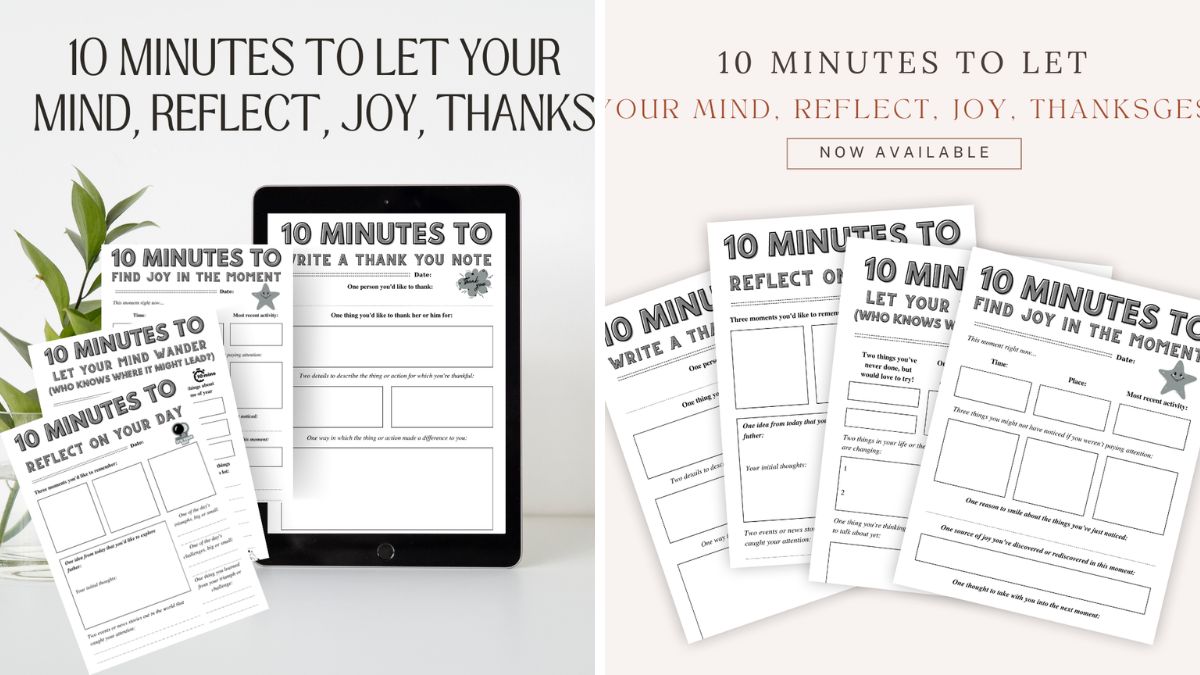
If blank pages create more resistance than freedom, consider 10 minutes to let your mind, reflect, joy, thanks / Editable Canva Template. The listing describes it as a journal and an editable Canva template centered on reflection, joy, and thanks, with customizable prompts and layouts. It includes one PDF with a Canva link and states that the Canva file contains 100 pages. Because it is editable, it may be a useful starting framework if you want guidance while still tailoring the experience to your preferences. Review the listing for current price and purchase details before deciding; it is a template, not a promise of a particular emotional outcome.
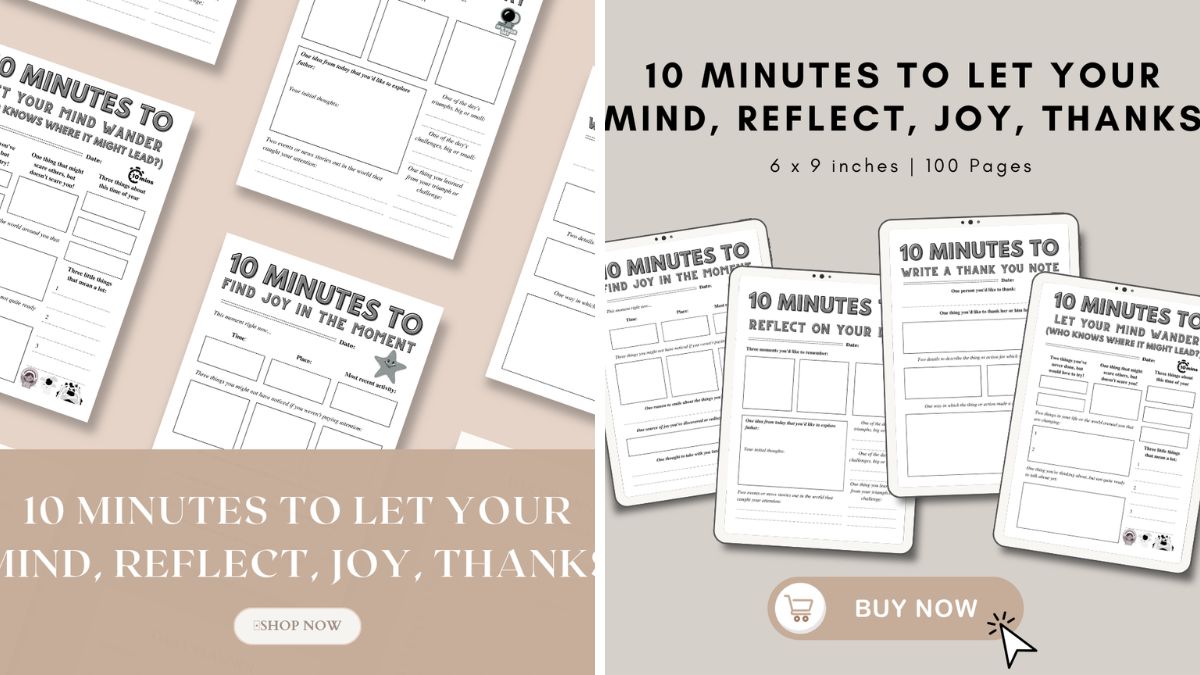
You do not need this resource to begin. A scrap of paper works. The value is in making a small pause easy to repeat, not in owning a particular format.
FAQ: Making a ten-minute practice last
Should I journal in the morning or at night?
Choose the time you can protect most consistently. Morning journaling can help you set a priority before outside demands arrive. Evening journaling can help you clear mental tabs and notice what happened. Try each for a week, then keep the version that feels more supportive than burdensome.
What if I have nothing meaningful to write?
Start with facts. Describe where you are, what you have done, and what your energy feels like. Then answer one low-pressure prompt, such as “What would make today kinder?” Meaning often appears after you begin, but it does not need to appear for the entry to count.
Is ten minutes of journaling a wellness treatment?
No. It is a personal reflection habit, not medical or mental-health treatment. It may help you organize thoughts or notice what you need, but experiences vary. If you are dealing with persistent distress, trauma, major changes in mood, or thoughts of self-harm, contact a qualified healthcare professional or an appropriate crisis service rather than relying on journaling alone.
Start with one honest page today
Set a timer for ten minutes. Put your phone on do-not-disturb, write the date, and answer these three prompts: What is taking up space? What is worth noticing? What is one next move? Stop when the timer ends, even if the page is unfinished.
Repeat tomorrow without trying to improve the aesthetic. After seven days, look back for one pattern: a recurring need, a reliable source of energy, or a boundary you keep postponing. Let that pattern guide one small change. That is the quiet power of a 10 minute journal practice: not a dramatic reinvention, but a dependable way to hear yourself clearly enough to choose what comes next.
About the Author