
What Staying Home Costs Moms - And How to Fix It Now
Nobody sits you down before you leave work and walks you through the math.
There’s no exit interview where someone says: here’s what this decision will cost your retirement account, here’s what it means for your Social Security benefit, here’s the number that represents your financial dependency risk if your marriage ever faces a serious challenge. There’s no spreadsheet that shows what happens to your credit score, your employability, or your lifetime earnings over a 5-year gap.
You make the decision — often the right decision, the one that makes sense for your family, the one you’d make again — and you figure out the financial details later.
This article is the conversation nobody had with you. Not to scare you. Not to reverse a decision that was right. But because the financial risks of being a stay-at-home mom are real, they’re specific, and — critically — every single one of them has a practical solution that doesn’t require you to go back to work full-time.
Here’s what’s actually at stake, and here’s what you do about each one.
The Retirement Gap: The Biggest Hidden Cost Nobody Calculates
Let’s start with the number that surprises people most.
If you worked before staying home and contributed to a 401(k), those contributions stopped the day you left. More importantly: compound interest stopped working for you on new contributions. The money already in the account keeps growing — but the powerful effect of time-and-compounding works best when contributions continue over decades, not when they pause for five, ten, or fifteen years.
Here’s what that pause actually costs. A 32-year-old who was contributing $5,000/year to a retirement account, who pauses for 10 years and resumes at 42: she doesn’t just lose $50,000 in contributions. She loses the compounded growth on those contributions for the remaining 25+ years until retirement. Depending on market returns, that gap can represent $150,000–$300,000 in retirement wealth. From a 10-year pause.

The fix: The Spousal Roth IRA. This is the most underused financial tool in stay-at-home mom life — and it directly addresses the retirement gap.
As long as your household has any earned income (your spouse’s income qualifies), you can contribute up to $7,000 per year to a Roth IRA in your own name. The contributions grow tax-free. Withdrawals in retirement are tax-free. The account belongs to you — not to the marriage, not to your spouse’s employer, to you legally and permanently.
If you haven’t been doing this, you may be able to make catch-up contributions for prior years — worth checking with a CPA immediately.
Every year you don’t open this account is a year of tax-free compound growth you’re leaving on the table. Open it this week.
The Social Security Gap: The Cost That Takes Decades to Show Up
Social Security benefits are calculated based on your 35 highest-earning years. If you have fewer than 35 years of earnings on record — which many stay-at-home moms do — the Social Security Administration fills in the missing years with zeros.
Those zeros drag down your lifetime benefit calculation in ways that are hard to fully appreciate until you’re looking at your projected benefit statement at 60 and wondering why the number is lower than you expected.
A woman who worked for 12 years before staying home for 10 has only 12 earning years on record. When Social Security calculates her benefit, it averages across 35 years — meaning 23 zeros are factored in alongside her 12 earning years.

The fix has two parts:
First, the Spousal Roth IRA (see above) partially offsets this by building retirement wealth that doesn’t depend on Social Security. The more wealth you build in your own retirement accounts, the less a reduced Social Security benefit matters.
Second, if you ever return to any paid work — freelance, part-time, your own online business — those earnings go on your Social Security record and replace some of those zeros. Even modest, consistent income over several years can meaningfully improve your eventual benefit.
This is one of the less-discussed reasons why building any income stream as a stay-at-home mom matters — it’s not just about money now. It’s about your financial record for the next several decades.
The Financial Dependency Risk: The Conversation Nobody Wants to Have
This section is uncomfortable. It’s also important.
Approximately 50% of marriages end in divorce. Widowhood is a statistical reality for most women, given average longevity differences. Disability, illness, job loss — life has a way of disrupting even stable arrangements without warning.
A stay-at-home mom who has been financially dependent for several years — no income, no retirement account in her name, no independent credit history, limited knowledge of household finances — is in a genuinely vulnerable position if any of these things happen.
This is not a reason to distrust your spouse. It is not a pessimistic reading of your marriage. It is a practical recognition that financial security within a partnership and financial security independent of a partnership are two different things — and every stay-at-home mom deserves both.

The practical fixes:
- Know all the numbers. Every account, every balance, every insurance policy, every investment. Not in a general way — specifically. Account numbers, login credentials, beneficiary designations, coverage amounts.
- Maintain independent credit. A credit card in your name alone, used for regular purchases and paid off in full monthly, keeps your credit score healthy and your financial identity active.
- Have your own savings. Even a modest personal account — a few thousand dollars — that is yours and accessible independently provides a meaningful buffer.
- Understand your legal rights. In most states, assets accumulated during marriage are marital property regardless of whose name they’re in. Know your state’s laws. Know what you’d be entitled to. Having the knowledge is not the same as expecting to need it.
The Career Re-Entry Cost: What Gaps Actually Do to Earnings
The research on this is consistent and worth knowing: career gaps are expensive.
A 2020 study found that women who take a career break of five or more years re-enter the workforce at salaries 18–37% lower than where they left — even when returning to the same field. Skills atrophy, networks thin out, industries evolve, and the “gap on the resume” creates implicit bias in hiring processes that is well-documented.
This doesn’t mean staying home was the wrong decision. For most moms, the calculation still favors it — especially when childcare costs are factored in. But it means that if you ever want or need to return to paid employment, the re-entry cost is real and it’s worth planning for.

The fixes that make re-entry easier:
- Keep skills current. Free and low-cost online courses in your field, or in new skills relevant to the work you’d want to do. An hour a week matters more than you think over three to five years.
- Maintain your professional network — even loosely. Former colleagues, LinkedIn connections, professional associations. Relationships don’t need constant maintenance; they need occasional contact.
- Build a portfolio of work. Freelance projects, volunteer work in your field, or your own online projects (a blog, a business, an Etsy shop) all demonstrate active skill use. They make the gap on your resume look like a different choice, not an absence.
- Consider building your own income. Moms who’ve built freelance income or an online business during their at-home years often find they don’t want or need to re-enter traditional employment — they’ve already built something.
The Invisible Labor Cost: What Your Work Is Actually Worth
Here is a number worth sitting with: the economic value of unpaid household and childcare labor performed by a stay-at-home parent has been estimated at $184,000 per year in replacement cost — the amount it would cost to hire people to perform all the functions a stay-at-home parent handles.
Cooking, cleaning, childcare, driving, managing schedules, household administration, emotional labor, healthcare coordination. These are not hobbies or choices that “don’t count.” They are economic contributions to your family’s functioning that simply don’t get compensated.

The financial risk embedded here: if something happens to you — illness, injury, death — your family would need to replace those functions. Often families only carry life insurance on the earning spouse, leaving the household completely underinsured for the real economic impact of losing the stay-at-home parent.
The fix: Term life insurance in your name. The coverage amount should reflect what it would actually cost to replace your functions — childcare, household management, the coordination role you fill. For most families with young children, this is meaningful coverage. And term life insurance premiums are often surprisingly affordable, especially when purchased young.
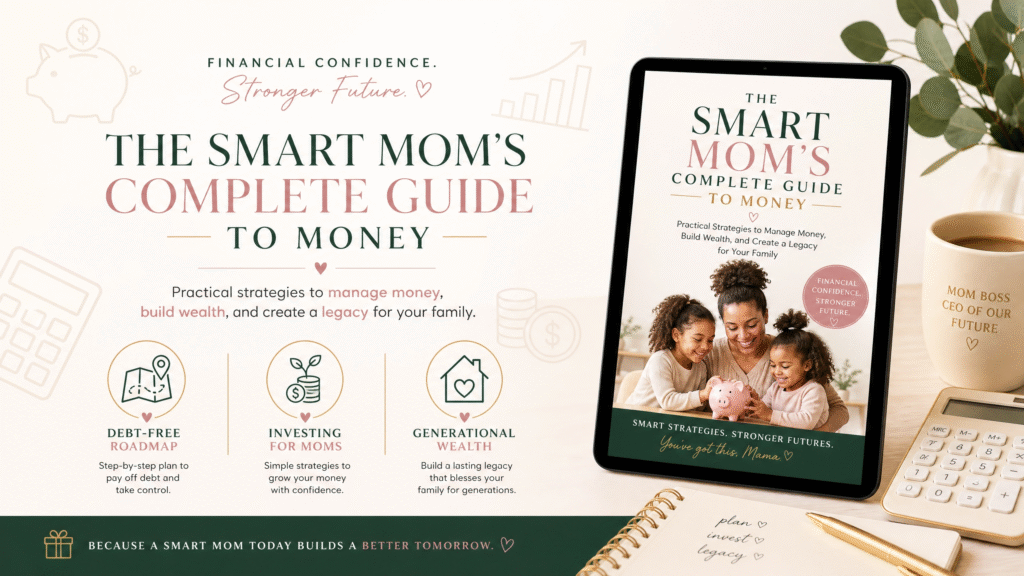
📘 The Smart Mom’s Complete Guide to Money addresses every one of these risks directly — with chapters on the Spousal Roth IRA, retirement planning for moms with career gaps, the financial power of stay-at-home moms within a marriage, insurance needs, Social Security strategy, and building complete financial knowledge. It also includes a full toolkit: budget template, debt payoff planner, 12-month net worth tracker, and a 90-day action plan.
4.9/5 stars from 1,800+ families. $27 (regular $47) with a full 30-day money-back guarantee.
The Income Solution: Building Yours Without Going Back Full-Time
Here’s the empowering flip side of everything above: almost every financial risk of being a stay-at-home mom is significantly reduced — sometimes eliminated — when you have income of your own.
Even modest income changes the picture dramatically:
- $500–$1,000/month covers Spousal Roth IRA contributions and starts building independent savings
- Consistent income on your record adds earning years to your Social Security history and replaces zeros
- Owning income changes the financial dependency dynamic in a marriage in ways that are hard to articulate but immediately felt
- Demonstrated earning ability dramatically reduces career re-entry anxiety — you didn’t leave the workforce, you changed how you work in it
The best part: building income as a stay-at-home mom in 2025 doesn’t require going back to an office, putting kids in full-time childcare, or abandoning the reason you chose to be home.

The Online Income Paths That Actually Work
Virtual assistant work is the fastest path — income within 1–3 weeks is genuinely achievable. Businesses pay $25–$75/hour for inbox management, scheduling, research, social media, content formatting, and customer support. Skills you already have. Platforms like Upwork connect you to clients without requiring a portfolio.
Digital products are the compound play. Create a template, planner, printable, or guide once on Canva (free) and sell it indefinitely on Etsy or Gumroad. One well-positioned product can generate income for years from a single afternoon of work. Ten products can generate meaningful monthly passive income.
Freelance writing, design, or bookkeeping bring what you know to clients who need it. If you have professional experience from before staying home, this is often the highest-paying path — your pre-existing skills have value in the freelance market that other beginners don’t have.
Affiliate marketing layers on top of any content you’re creating — a blog, a Pinterest account, an Instagram — and earns commission on products you genuinely recommend. No product creation. No customer service. Just honest recommendations and links.
Blogging is the long game (6–12 months to meaningful revenue) that builds the most durable asset. An audience that trusts you can be monetized through ads, affiliates, digital products, and courses simultaneously.
The golden rule: pick one method, work it for 30 focused days, then evaluate. Not research paralysis across all five. One method, thirty days, genuine effort.
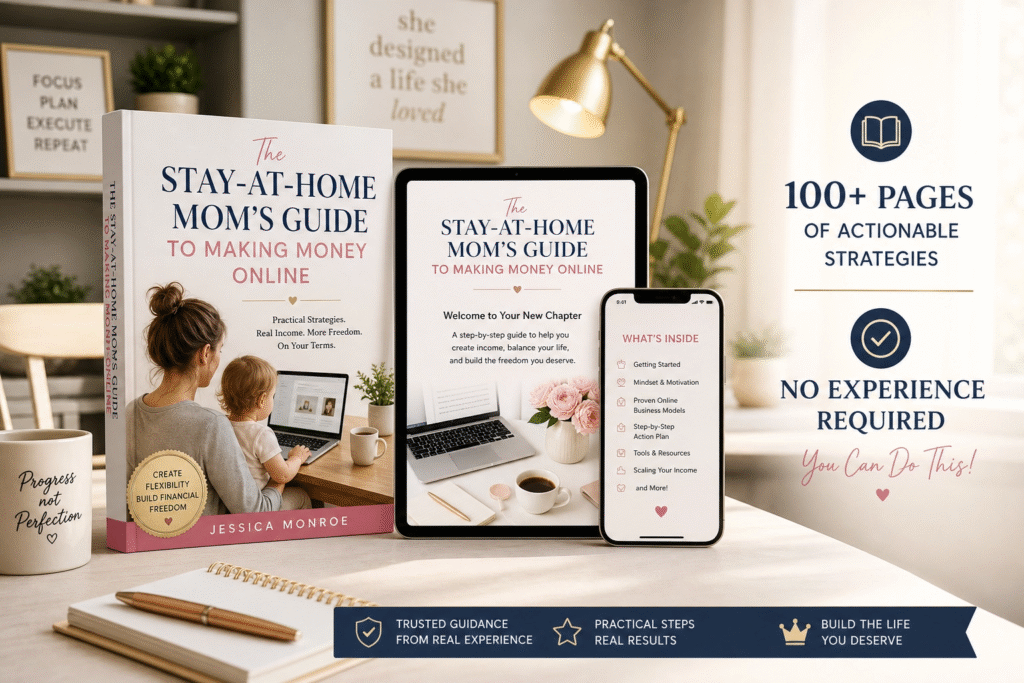
📗 The Stay-At-Home Mom’s Guide to Making Money Online covers all 12 income methods in step-by-step detail — including virtual assistant work, digital products, freelancing, affiliate marketing, blogging, print-on-demand, social media monetization, and online courses. Each chapter includes specific platforms, tools, startup costs (most: $0), and a 30-day action plan to your first dollar.
Rated 4.9/5 by 2,400+ moms. Built for 30-minute work windows. $27 with a 30-day money-back guarantee.
→ Get The Stay-At-Home Mom’s Guide to Making Money Online — $27
What Eyes-Open Looks Like
Here’s the version of stay-at-home mom life that the women who’ve figured this out are living:
She knows her family’s net worth to the dollar. She has a Spousal Roth IRA that she maxes out every year — contributions that are building her own retirement regardless of what her household looks like at 65. She has a credit card in her name, a savings account in her name, and a Gumroad shop that made $400 last month from digital products she made during nap time.
She’s not afraid of any of the numbers. Not the debt (she has a payoff date). Not the retirement picture (she’s building it). Not the question of what would happen if things changed (she knows, and she’s prepared).

She made the same choice you made — to be home with her kids. She just made sure she wasn’t financially invisible while she did it.
That version of this life is available to you. Not through a dramatic pivot or a sacrifice of the reasons you stayed home. Through a series of specific, practical decisions — made one at a time, starting this week.
The risks are real. The solutions are real too.
Your Action List: This Week, This Month, This Year
This week:
- Check whether you have a Spousal Roth IRA. If not, open one.
- Create a list of every account, policy, and investment in your household — make sure you have access to all of them
- Research term life insurance coverage for yourself (not just your spouse)
This month:
- Complete a full debt inventory with interest rates and your debt-free date
- Open a high-yield savings account in your name if you don’t have one
- Pick one online income method and spend 30 focused days on it

This year:
- Max out your Spousal Roth IRA contributions ($7,000 for 2025)
- Build or expand an independent income stream to $500+/month
- Have one honest money conversation with your spouse using your complete financial picture — together
The goal isn’t to undo the choice you made to stay home. It’s to make sure that choice comes with full financial protection, full financial knowledge, and income that’s yours.
You deserve all three.
This post contains affiliate links. We may earn a small commission at no extra cost to you. We only recommend resources we’ve genuinely reviewed and believe in.
About the Author