
How to Actually Glow Up Your Life - The System That Works
You’ve made the list before. The one with the 5am wake-up, the green juice, the journaling habit, the weekly workout plan, the reading goal. You taped it to the mirror or set it as your phone wallpaper and felt genuinely good about it for about eleven days.
Then life happened. One bad morning became a missed habit. One missed habit became a broken streak. One broken streak became quiet proof of something you already feared about yourself — that you’re someone who starts things and doesn’t finish them.
Here’s the thing nobody says out loud: that’s not a character flaw. It’s a system failure.
A real glow up — the kind that actually holds, the kind that makes you different a year from now instead of just motivated for a week — doesn’t start with habits. It starts somewhere deeper. And once you understand where, everything else gets easier in a way that feels almost unfair.
Why Most Glow Ups Fail by Week Two
Think about the last time you tried to build a new habit. Maybe you committed to working out every morning. Or cutting out sugar. Or reading before bed instead of scrolling.
You knew what to do. You had the information. You might have even had the time. And still, somewhere around day ten or fourteen, it quietly dissolved.
The reason isn’t willpower. The reason isn’t motivation. The reason is that you were trying to act like a version of yourself you didn’t yet believe you were.
You were attempting the behaviors of a “disciplined person” while internally still identifying as someone who “tries but never sticks with things.” That identity — that story you carry about who you are — quietly, consistently pulled you back toward what felt familiar.
Identity drives behavior. Not the other way around. And until you address the identity layer, every habit attempt is a fight against your own self-concept. Which is exhausting. And which you will lose every time.
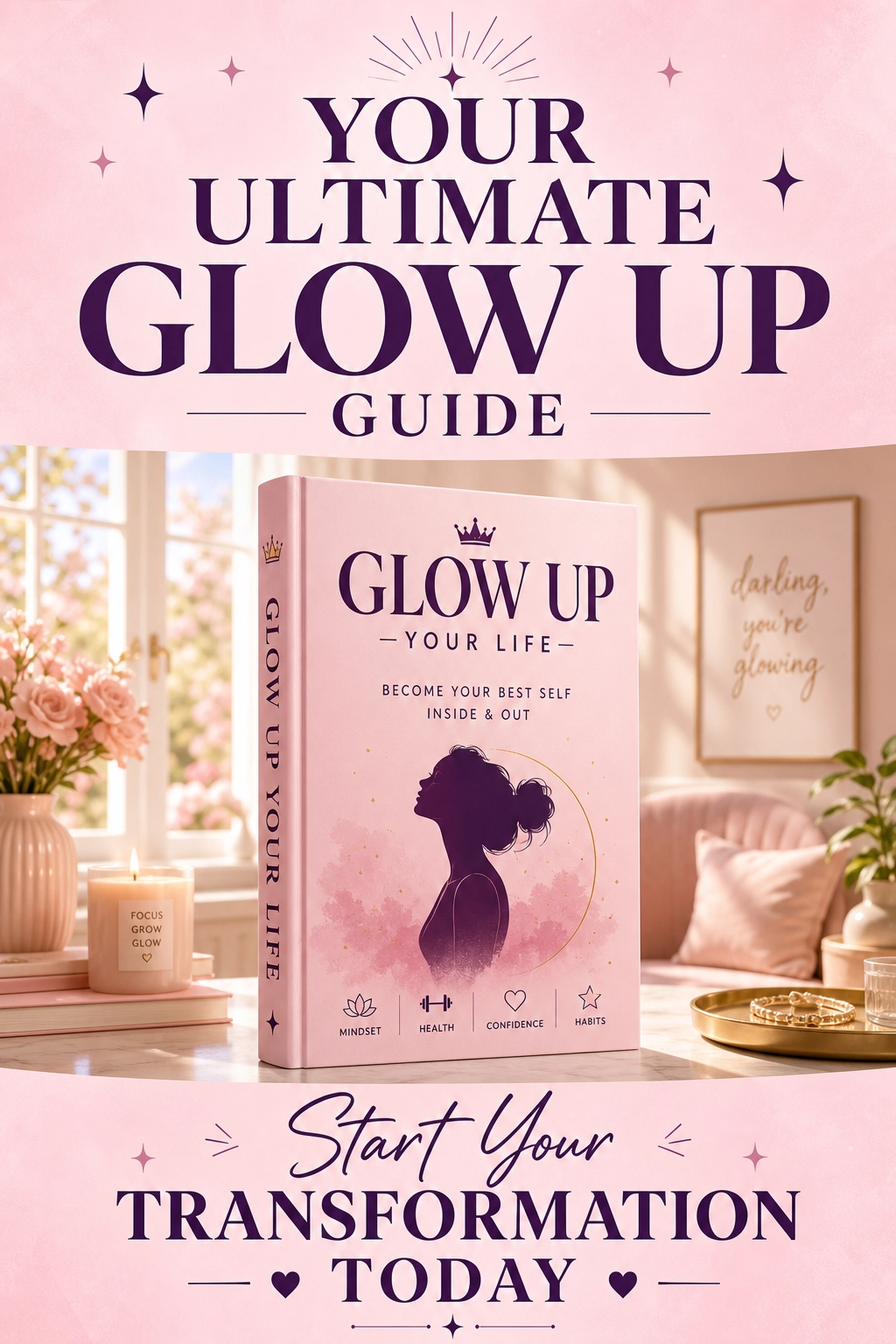
This is the insight at the core of Glow Up Your Life — a 70-page self-transformation system from LadyBossIncome that approaches personal change in exactly the order it actually works.
What a Real Glow Up Actually Covers
The word “glow up” has been flattened by social media into a before-and-after visual — new hair, new wardrobe, maybe a fitness transformation. And while none of those things are bad, they’re surface. They’re the output of a glow up, not the cause of one.
A real glow up — the kind that lasts, the kind that changes how you move through the world — touches every layer:
Who you believe you are. The stories you carry about your capabilities, your worth, your potential. These run silently in the background of every decision you make.
How you operate daily. Your habits, your mornings, your defaults when you’re tired or stressed or pressed for time. Systems, not willpower.
How you relate to others and yourself. The relationships you invest in, the boundaries you hold, the way you talk to yourself when no one’s listening.
What you’re building toward. A vision — specific, written, revisited — of the life you’re actually trying to create.
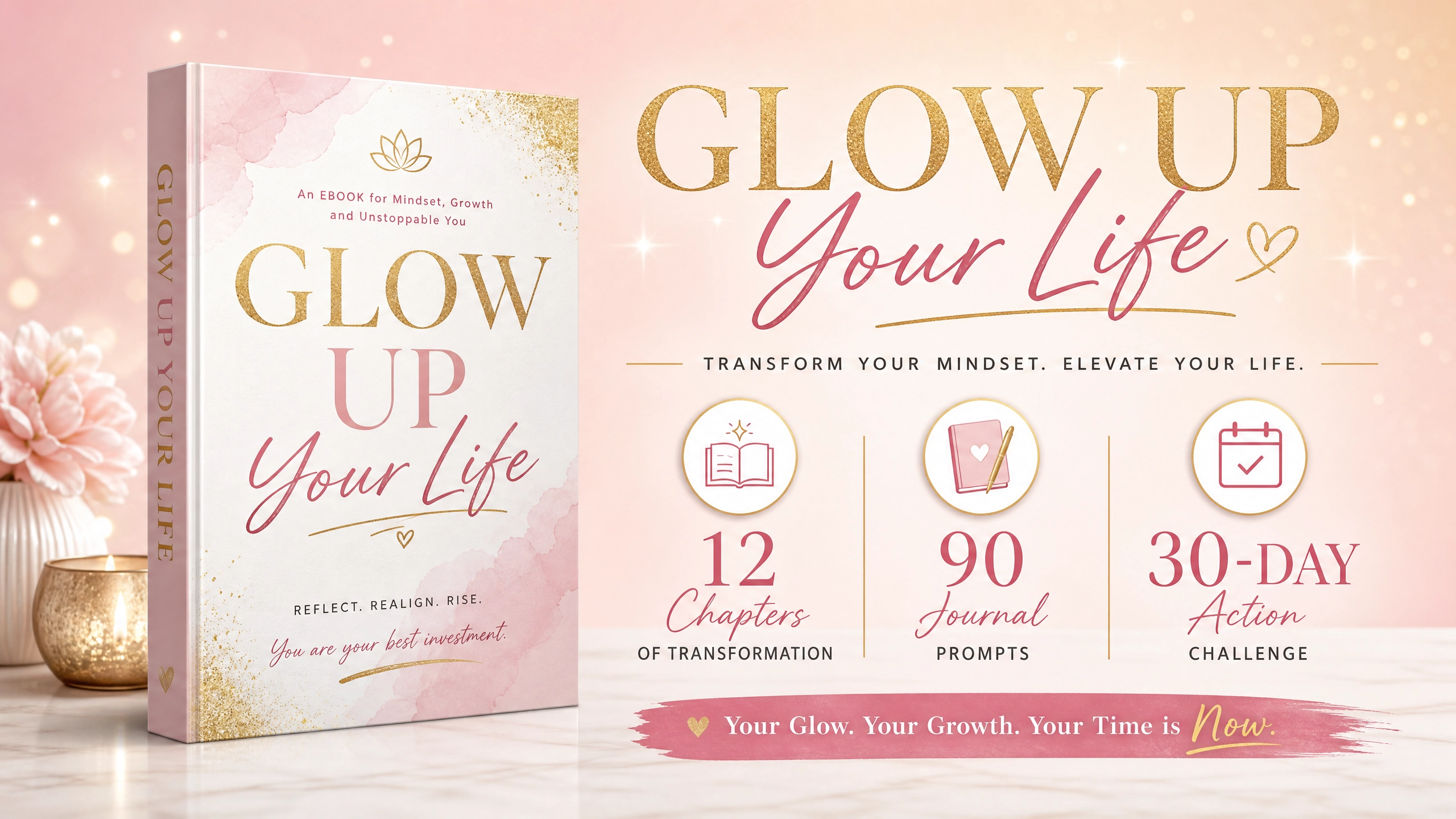
Glow Up Your Life covers all of it. Twelve chapters across identity, habits, morning routines, self-care, confidence, mindset, relationships, finances, productivity, physical wellness, digital wellness, and vision. It’s holistic by design, because the book makes a compelling case early: you cannot sustainably transform one area of your life while ignoring the others. Everything is connected.
The Chapter That Changes Everything First
Chapter 1 is called “Who You Are Becoming” — and multiple readers say they reread it before moving on.
It introduces the “I am” inventory: a written exercise where you surface every identity statement you’ve been carrying. I am someone who’s bad with money. I am someone who can’t stick to a routine. I am someone who gets overwhelmed easily. Then you examine each one. Where did it come from? Is it actually yours? Is it still true? Does it serve the life you’re trying to build?
Most of those statements aren’t truths. They’re conclusions drawn from old evidence — a failure in your twenties, something a parent said, a period when things genuinely fell apart. They got filed as identity rather than data, and they’ve been quietly running your behavior ever since.
The exercise doesn’t ask you to fake confidence or repeat affirmations you don’t believe. It asks you to question the old stories, collect new evidence for who you’re becoming, and design — deliberately — the identity you want to grow into.
It sounds simple. It is genuinely one of the more confronting things you can sit with.
The Habits Chapter Is Different From Every Habits Book You’ve Read
Chapter 2 on habits builds on the identity framework rather than treating habits as a standalone project. The research-backed insight it centers: you don’t build discipline and then become disciplined. You decide you’re a disciplined person, and then the habits stop feeling like a fight.
The practical tools in this chapter are solid — habit stacking, the morning and evening stack design, the Four Laws applied specifically to a glow up context. But the standout is the two-day rule: never miss the same habit twice in a row.
Not: never miss. Not: protect your streak at all costs. Just — if you miss once, the next day is non-negotiable.
This single rule dissolves the perfectionism spiral that kills most habit attempts. One miss is human. Two misses is the start of a new (unwanted) habit. The recovery matters more than the streak.
The Morning Routine Chapter Does Something Rare: It Starts With Science
Morning routine content is one of the most oversaturated categories in self-improvement. Most of it is aspirational fantasy — a 5am alarm, a cold plunge, a 90-minute journaling session, somehow without a child yelling or a job to get to.
Chapter 3 earns its place by opening with physiology instead of aesthetics. The cortisol awakening response — the natural alertness spike your body produces in the first 30–45 minutes after waking — is one of the most underused tools in your biology. What you do with that window sets the neurological tone for your entire day. Most people spend it on their phones, flooding that window with other people’s urgency before they’ve even processed their own.
The chapter then does something most morning routine guides don’t: it asks you to design your routine, for your life, based on what you actually want your mornings to feel like. Not a template borrowed from a productivity influencer. Anchor habits that take under ten minutes, an optional stack to add when time allows, and a design flexible enough to survive a Tuesday when everything goes sideways.
That’s a morning routine that actually sticks.
The Parts of the Glow Up Nobody Glamorizes (But That Matter Most)
The chapters that don’t get the Pinterest treatment are often the ones with the highest leverage.
Chapter 7: Relationships. The relationship audit — honest, sometimes uncomfortable — asks you to look clearly at who you spend the most time with and what each relationship is actually costing or giving you. The radiators-vs-drains framework is simple and ruthless in the best way. It also covers the romantic relationship during a personal transformation, which is a topic most self-improvement books skip entirely despite being one of the most real challenges anyone doing this work faces.
Chapter 8: Financial Glow Up. The money chapter is one of the strongest in the book — and probably the one most women will approach with the most resistance. It applies the identity-first framework directly to finances: before you build a budget or an investment plan, you examine your money story. The beliefs you absorbed about money growing up. The emotions attached to earning, spending, saving. Because no budgeting system in the world survives a broken money identity. Reader Keisha saved $1,200 in three months following the system in this chapter alone.
Chapter 11: Digital Wellness. This one is quiet and lands hard. The attention economy — the deliberate, engineered design of every app on your phone to capture and hold as much of your cognitive bandwidth as possible — is not a neutral force in your glow up. It’s an actively opposing one. This chapter doesn’t ask you to delete everything. It asks you to design your digital environment with the same intentionality you’d bring to designing your physical one.
The Bonuses That Make the Book Worth It Twice Over
The 30-Day Glow Up Challenge. One specific, achievable action per day for 30 days, touching every pillar of your transformation. Not overwhelming. Not vague. Just one thing, every day, building 30 pieces of evidence for your new identity.
90 Days of Journal Prompts. This bonus alone is worth the price of entry for anyone who journals or has wanted to start. These aren’t “what are you grateful for today” prompts. They’re deep, specific, organized across identity, goals, relationships, money, and life design. Questions that surface the beliefs and patterns actually determining where you end up a year from now. Ninety of them. Enough to carry you through an entire season.
Sample prompt — and this one will sit with you: What old “I am” story have you been carrying that was never actually yours — it came from someone else and you adopted it without questioning it?
The Glow Up Resource Library. A curated reading and practice list for every chapter of your journey. Not comprehensive — curated. The distinction matters.
Who This Book Is For (Be Honest With Yourself Here)
This is the book for you if any of the following is true:
You’ve tried self-improvement and it hasn’t stuck — not because the ideas were wrong, but because no one showed you the order in which the pieces go.
You’re at a turning point. Post-burnout, post-relationship, post-a-season-that-drained-you, or just the quiet internal knowing that something needs to shift and it needs to shift now.
You want a system, not a mood board. You’re done collecting inspiration. You’re ready for a blueprint.
You’ve been hard on yourself for “not having it together” — and you’re finally willing to consider that the problem was never your character. It was the missing architecture.
This probably isn’t for you if you already have a working personal development system you’re happy with, or if you want specialized depth on a single area (an entire book on habits, or an entire book on money). This book is wide and intentional — twelve areas covered with enough depth to move you forward in each.
The Investment — and What It Actually Costs You to Wait
Glow Up Your Life is $57. It’s a 70-page PDF with 12 chapters, three bonus chapters, four appendices (including a 12-month goal tracker, habits worksheets, morning and evening routine templates, and a glow up glossary), and a 30-day money-back guarantee.
For $57, you get the system. What you do with it is on you.
The part nobody says: the cost of not starting isn’t zero. Every year you spend in the same patterns, running the same old identity stories, getting the same results — that’s a cost too. It just doesn’t show up on a receipt.
The woman you’re becoming is waiting in your next decision. Not the next big life overhaul. Just the next small, intentional, aligned choice.
→ Start Your Glow Up — $57 · Instant PDF · 30-day money-back guarantee
Make the Ritual Feel Like Yours
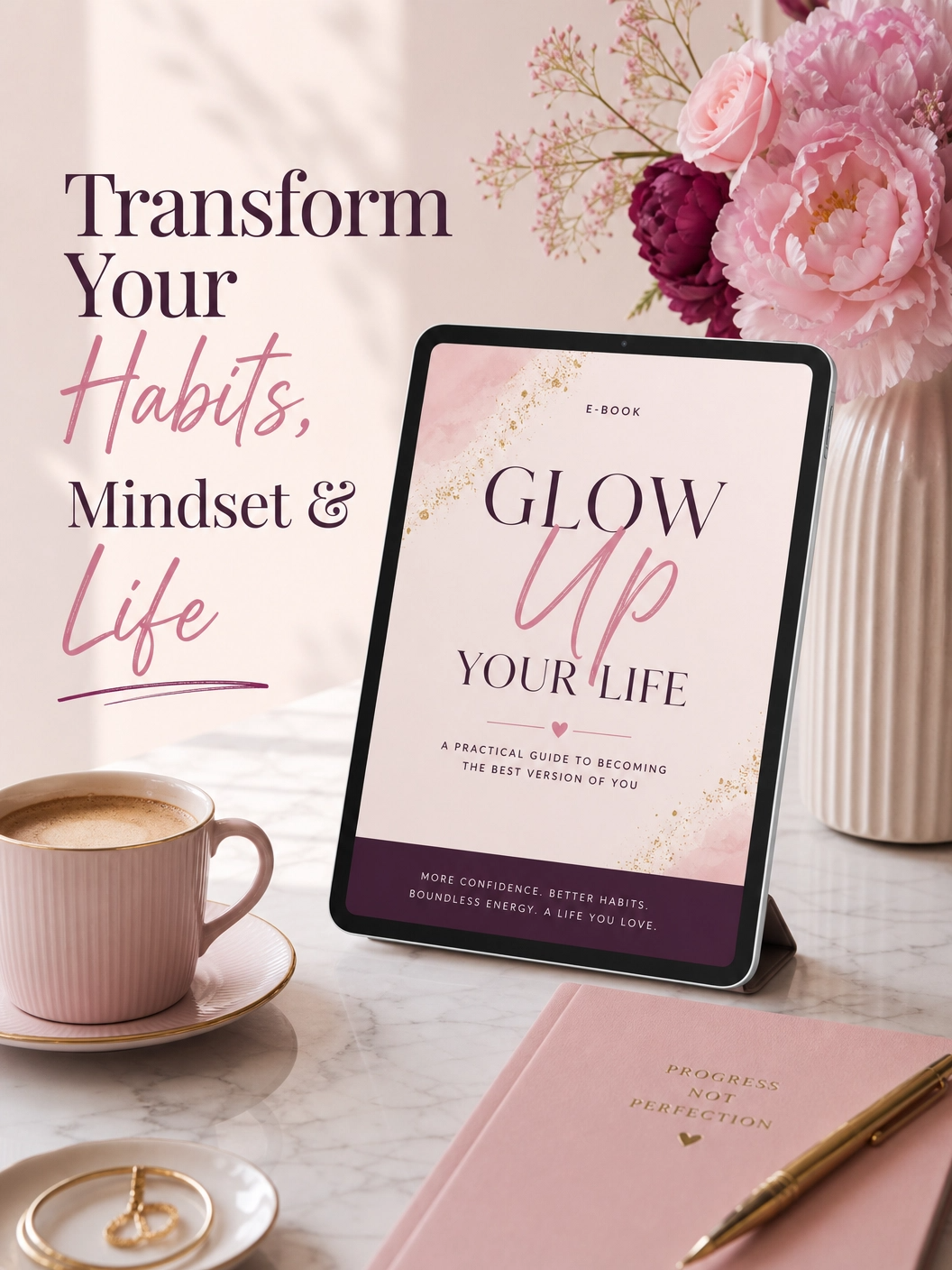
Here’s something the book addresses beautifully and that we believe completely: environment shapes behavior. The details of your daily life — what you reach for in the morning, what your workspace looks or feels like, the small rituals that signal to your brain that this time is intentional — matter more than most people give them credit for.
If you’re building a new morning practice, a journaling habit, or just carving out a quiet hour that belongs to you — the right mug is part of that environment. Not because it’s magical, but because it’s physical proof that you took the time to set the stage.
This Mom is My Home Watercolor Cottage Mug from omniinspo has watercolor cottage garden energy — soft, botanical, entirely unhurried. The kind of thing that sits on your desk and quietly confirms: this hour is mine.
→ Shop it: Mom is My Home Watercolor Cottage Mug — $19.99
And if you’re gifting the book — to a sister, a best friend, the woman in your life who’s been ready for her next chapter — pair it with something that says you see her. The Love You Mom Cute Bear Hug Mug from omniinspo is warm, sweet, and entirely her — a cozy reminder that she is loved exactly while she becomes more fully herself.
→ Shop it: Love You Mom Cute Bear Hug Mug — $19.99
Frequently Asked Questions
I’ve started and abandoned self-help books before. What makes this different?
The most common reason people abandon self-help books is the gap between reading and acting — inspiration without implementation produces no change, which feels discouraging and reinforces the “I can’t stick to things” story. Glow Up Your Life is designed around action: every chapter ends with a specific step completable in 30 minutes, and the 30-Day Challenge makes starting frictionless with one action per day.
I’m really busy. How long does this actually take?
The book is 70 pages — readable in one focused sitting or across a week of 15-minute sessions. Each chapter action takes 30 minutes or less. The 30-Day Challenge is one action per day. It was written specifically for women with full lives, not unlimited time.
Does it cover everything or just one area?
Everything — identity, habits, morning routines, self-care, confidence, mindset, relationships, finances, productivity, physical wellness, digital wellness, and vision. The premise is that a real glow up is holistic. You can’t sustainably transform one area while the others are actively working against it.
Is there a refund policy?
Full 30-day money-back guarantee, no questions asked. You take zero risk.
This post contains affiliate links. We may earn a small commission at no extra cost to you.
About the Author