
Why You're Always Tired (It's Not What You Think) - Hormone Health Guide
You’re sleeping. You’re taking your vitamins. You’ve cut back on caffeine, tried going to bed earlier, downloaded the meditation app. And you still wake up exhausted — the kind of exhausted that a good night’s sleep doesn’t fix, that coffee only temporarily masks, that no amount of “rest more, stress less” advice touches.
You’ve probably had bloodwork done. And you’ve probably heard the four words that are somehow more frustrating than a bad result: everything looks completely normal.
Normal. While you’re dragging yourself through days that used to feel manageable. While your brain is foggy by 2pm. While the weight you’ve been trying to shift hasn’t moved in months despite doing everything right. While your sleep fragments at 3am for no apparent reason. While your mood swings in ways that feel less like “you” and more like a different person wearing your face.
Here’s what most standard medical appointments don’t have time to tell you: “normal” is not the same as “optimal.” And for millions of women, the gap between those two words is where they’ve been living — unwell, dismissed, and quietly convinced something is wrong with them rather than with the testing.
The Hormone Balance Blueprint by LadyBossIncome was written for exactly that woman. Here’s what it covers, why it’s different from everything else in the hormone health space, and whether it might be the missing piece you’ve been looking for.
Important note: This article is educational, not medical advice. Always consult a qualified healthcare provider before beginning any new health protocol or supplement regimen.
The Four Things Nobody Told You About Your Hormones
Before we get into the book, let’s address the actual mechanisms — because understanding why you feel this way changes everything about how you approach fixing it.
1. Cortisol Is Disrupting Everything Else
Cortisol is your primary stress hormone — and in small, well-timed doses, it’s essential. It gives you the morning alertness spike that gets you out of bed. It helps you respond to real demands.
The problem is chronic cortisol elevation. When your nervous system is in a sustained stress response — which, for most modern women, is essentially always — cortisol begins “stealing” the raw materials your body needs to make other hormones. Progesterone drops. Thyroid conversion slows. Insulin resistance builds. Sleep architecture fragments.
You can take every thyroid supplement, every progesterone cream, every adaptogen on the market — and if your cortisol is dysregulated, most of it won’t stick. Cortisol is the master disruptor. Everything else depends on addressing it first.
2. Your Thyroid Test Is Probably Missing the Real Picture
The standard thyroid panel most doctors run is TSH — thyroid stimulating hormone. It’s a reasonable screening tool. It’s also remarkably easy to pass while still experiencing significant hypothyroid symptoms.
Here’s why: TSH measures how hard your pituitary gland is working to stimulate your thyroid. It doesn’t measure what your thyroid is actually producing (Free T4), or — more importantly — what your body is actually converting and using (Free T3). It doesn’t test for the antibodies that indicate Hashimoto’s autoimmune thyroiditis. It doesn’t test reverse T3, which can block thyroid function even when other numbers look fine.
A “normal” TSH with low Free T3, elevated reverse T3, or positive antibodies means your thyroid function is impaired in ways the standard test simply doesn’t capture. Requesting the full panel isn’t being difficult — it’s asking for the information you actually need.
3. Insulin Resistance Is the Root Nobody Addresses
High insulin is the driver behind PCOS. It accelerates thyroid dysfunction. It depletes progesterone. It causes the menopausal weight gain that doesn’t respond to calorie restriction. It contributes to estrogen dominance. And it exists on a spectrum that begins years — sometimes a decade — before it shows up on a standard fasting glucose test.
The frustrating part: standard bloodwork typically measures fasting glucose. It doesn’t measure fasting insulin — which is where insulin resistance lives in its early, entirely-reversible stages. Most women with significant insulin resistance have been told their blood sugar is fine.
4. Your Gut Is Running Your Hormones
The estrobolome — a specific community of gut bacteria responsible for metabolizing and clearing estrogen — is one of the most consequential things most women have never heard of. When your microbiome is disrupted, estrogen that should be cleared gets recirculated. Estrogen dominance builds. PMS worsens. Weight concentrates around the hips and abdomen. Moods swing.
Your gut also handles about 20% of thyroid hormone conversion from inactive T4 to the active T3 your cells actually use. And it produces roughly 90% of your serotonin. A disrupted microbiome doesn’t just cause digestive symptoms — it creates hormonal chaos that no amount of supplementation can reliably override.
These four mechanisms — cortisol dysregulation, incomplete thyroid testing, undetected insulin resistance, and gut disruption — account for the majority of hormonal symptoms that get dismissed as “normal aging,” anxiety, or just the cost of being busy. They’re real. They’re measurable. And they’re largely addressable.
What The Hormone Balance Blueprint Actually Gives You
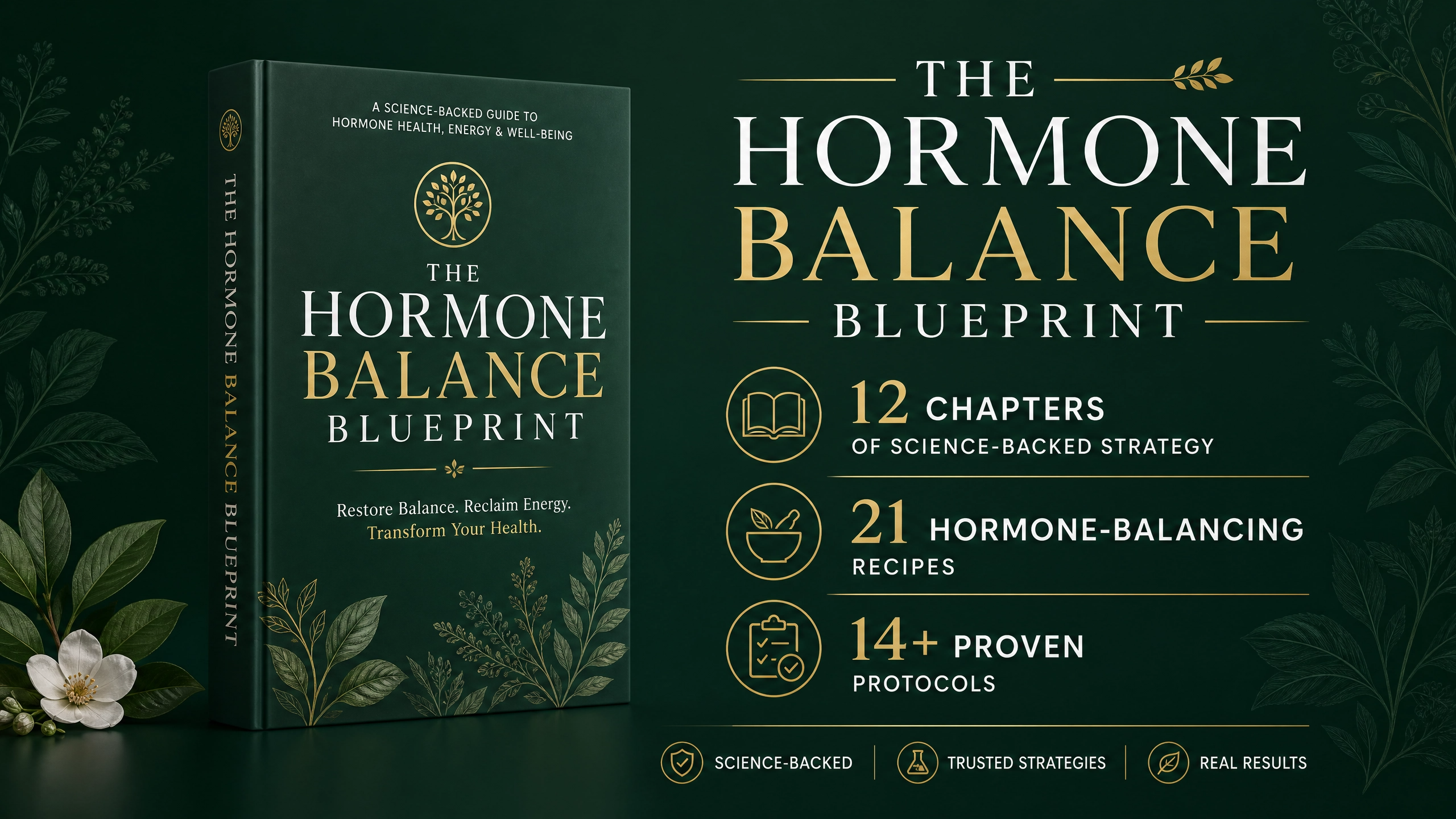
The Hormone Balance Blueprint is a 72-page science-backed guide that covers all of the above — and more — in plain language built for women without a medical background. It’s organized into 12 chapters, three bonus sections, and four appendices, with a 12-month phased protocol that sequences everything in the order that actually produces results.
Here’s what makes it genuinely different from the wellness content you’ve already consumed.
It Treats Your Hormones as a System, Not a List of Separate Problems
Most hormone content focuses on one area — cortisol or thyroid or estrogen or gut health. This is how most medical appointments work too: you see a GP for fatigue, an endocrinologist for your thyroid, a gynecologist for your cycle, a gastroenterologist for your gut — and nobody is ever looking at the whole picture.
The Hormone Balance Blueprint covers every major hormone system, and more importantly, shows how they interact. Cortisol suppresses thyroid. Thyroid dysfunction drives weight gain and insulin resistance. Insulin resistance worsens estrogen dominance. Estrogen dominance disrupts progesterone. Disrupted progesterone worsens sleep. Poor sleep elevates cortisol. It’s a loop — and treating any single node of the loop in isolation is why so many women see partial results that don’t last.
It Gives You the “Optimal vs. Normal” Lab Framework
This is the section that readers consistently describe as the most valuable thing in the book — and it’s genuinely rare.
The book includes a complete lab reference (Bonus 3) that lists every major hormone test, the conventional “normal” reference range, and the functional optimal range — what the research suggests your levels should be for optimal energy, mood, metabolism, and quality of life, not just absence of disease.
The difference matters enormously. A TSH of 3.8 is “normal” by most lab standards. But functional medicine research suggests optimal is closer to 1.0–2.0. A woman with TSH of 3.8, low Free T3, and low ferritin has been told her thyroid is fine. She feels anything but. Chapter 11 explains why — and gives her the language and reference points to have a different conversation with her provider.
Reader Dr. Meredith K. — a dentist who had spent thousands on functional medicine appointments getting fragments of information — describes bringing the lab reference appendix to her doctor and walking out with every test ordered. Her TSH moved from 3.8 to 1.6 in four months.
The 12-Month Protocol Is Sequenced for a Reason
One of the most common mistakes in hormone health work is adding complexity before the foundations are stable. Women buy five targeted supplements before they’ve addressed their sleep, their cortisol rhythm, or their gut. The supplements help a little. Nothing resolves. The protocol gets abandoned.
The 12-month roadmap in this book is specifically designed to prevent that. It unfolds in four phases:
Phase 1 (Months 1–3): Foundation. Cortisol reset, sleep, gut health, nutrition basics, foundational supplements. Nothing targeted yet — just building the stable base that makes everything else work.
Phase 2 (Months 4–6): Targeted Optimization. Based on your actual lab results from Month 1, you add targeted protocols — DIM for estrogen clearance, Vitex for progesterone support, berberine for insulin sensitivity, selenium for thyroid conversion. Retest at Month 6 and compare.
Phase 3 (Months 7–9): Deepen What Works. Build on your highest-impact changes. If significant imbalances persist despite solid foundations, this is when functional medicine evaluation adds the most value.
Phase 4 (Months 10–12): Integration and Longevity. Retest comprehensively. The woman finishing Month 12 is not the same woman who started Month 1. Document the difference. Plan Year 2.
The sequence is the strategy. Most women who see results don’t find a magic protocol — they find the right order.
The Chapters That Will Surprise You
Chapter 7: Perimenopause — The 10–15 Year Timeline Nobody Mentions
If you’re in your late 30s or early 40s and things have started to feel different — sleep disrupted, moods shifted, cycles irregular, weight redistributing — and you’ve been told you’re too young for perimenopause: this chapter was written for you.
The transition begins, on average, 10 to 15 years before your final period. Progesterone falls first, often starting in the mid-30s. The symptoms that arrive in that window are real hormonal shifts — not anxiety, not stress, not aging badly. This chapter covers the timeline, why progesterone falls first and what to do about it, an evidence-based overview of bioidentical HRT, and post-menopausal longevity priorities for bones, cardiovascular health, and cognitive function.
For any woman who has felt blindsided by perimenopause symptoms and met with dismissal, this chapter is genuinely validating.
Chapter 5: Insulin — The Root Most Doctors Never Address
If you have PCOS, unexplained weight gain concentrated around the abdomen, energy crashes after meals, or a history of being told your blood sugar is fine while feeling metabolically off — this chapter is the missing piece.
The meal sequencing framework here (protein and fiber before carbohydrates) is one of the simplest, most impactful protocol changes in the book. No special diet. No calorie counting. Just a change in order that meaningfully reduces the blood sugar and insulin spike of any meal.
Reader Priya A. — a software engineer with PCOS who had spent three years looking for the connection between her symptoms — implemented the blood sugar protocol and lost 14 pounds in three months without tracking a single calorie. Her cycles normalized in the same window.
The Supplement Reference: Finally, Specific Numbers
The foundation supplement stack covered in the book — magnesium glycinate, vitamin D3+K2, omega-3s, and methylated B-complex — costs approximately $40–60 per month and addresses the most widespread deficiencies in women’s hormonal health.
Every supplement includes exact dosing, timing, primary hormonal target, and notes on interactions. You don’t have to guess. You don’t have to piece it together from twelve different wellness accounts giving contradictory advice.
The book is clear throughout: all supplementation should be individualized with a healthcare provider, especially for targeted protocols and anyone with existing conditions or medications. This is a framework, not a prescription.
Who This Book Is For
You’ll find genuine value in this book if any of the following is true:
You’ve been told your labs are normal but still feel unwell. This book explains exactly why that can happen and gives you a roadmap to a more useful conversation.
You’re navigating perimenopause or approaching it. Chapter 7 alone addresses the gap in information most women experience at this transition.
You have PCOS, Hashimoto’s, or a thyroid diagnosis and want the full picture. The book covers how these conditions connect to the rest of your hormonal health, not just in isolation.
You’re dealing with unexplained fatigue, weight resistance, brain fog, poor sleep, severe PMS, or hair thinning. These symptoms have mechanisms. This book explains them.
You want to arrive at your next appointment genuinely prepared. The lab reference appendix is printable and designed exactly for this.
This book is not a replacement for medical care, and it says so clearly throughout. Think of it as the education that makes your medical care more effective — so that when you walk into an appointment, you’re asking the right questions, requesting the right tests, and understanding what the answers mean.
The Investment
The Hormone Balance Blueprint is $57 — a one-time payment for a 72-page PDF with lifetime access and a 30-day money-back guarantee.
For context: a single functional medicine appointment typically runs $200–$400. A comprehensive lab panel can run $300–$500 out of pocket. This book doesn’t replace either of those things. What it does is help you use them more effectively — knowing what to ask for, understanding what the results mean, and arriving with a protocol framework your provider can work with rather than starting from scratch.
Reader Jenna M. — a nurse practitioner — was told her labs were completely normal for eight years while gaining 30 pounds, losing half her hair, and barely functioning. She describes the book’s contribution simply: it taught her what to test, and what optimal actually looks like. She wasn’t broken. She was asking the wrong questions.
→ Get The Hormone Balance Blueprint — $57 · Instant PDF · 30-day guarantee
The Morning That Sets the Hormonal Tone for Everything
Chapter 2 on cortisol makes a point worth returning to: your first hour is the highest-leverage hour of your day. Morning light, a protein-first breakfast, no phone before you’ve had 20 quiet minutes — these aren’t lifestyle aesthetics. They’re inputs into a biological system that determines your energy, your mood, and your hormonal rhythm for the next 16 hours.
Building that kind of morning requires a little intention. The right environment helps — not because it’s magic, but because it signals to your nervous system that this time belongs to you.
For the woman building a new morning ritual around her health: this Graceful Like a Mother Botanical Mug from omniinspo has dried botanical elegance that makes a quiet kitchen feel like a real sanctuary. The kind of beautiful, intentional detail that makes a new habit feel worth protecting — day after day, which is exactly what any protocol requires.
→ Shop it: Graceful Like a Mother Botanical Mug — $19.99
Frequently Asked Questions
Is this book a substitute for seeing a doctor?
No — and it’s designed explicitly not to be. It’s educational, written to help you understand your hormonal health, ask better questions, and interpret your lab results with context. Every supplement recommendation includes a note to work with a provider. Think of it as the preparation that makes your medical appointments more productive.
I’ve already seen multiple doctors and been told everything is normal. Is this still for me?
This is written specifically for you. The lab reference appendix covers the difference between conventional normal ranges and functional optimal ranges for every major hormone test — and gives you the language to have a different conversation.
I’m in perimenopause. Is this relevant?
Chapter 7 covers perimenopause and menopause in depth — the timeline, the hormone shifts, the evidence on HRT, and post-menopausal longevity priorities. Highly relevant.
Do I need to buy a lot of supplements?
The foundation stack costs approximately $40–60/month and covers the most widespread deficiencies. Targeted supplements are optional additions based on your specific test results. The nutrition chapter is built around whole foods available at any grocery store — no specialty purchases required.
What if I don’t find it valuable?
Full 30-day money-back guarantee, no questions asked.
This post contains affiliate links. We may earn a small commission at no extra cost to you. This article is for educational purposes only and does not constitute medical advice. Please consult a qualified healthcare provider before beginning any new supplement or health protocol.
About the Author