The New Stay-At-Home Mom Career - Finance & Income Guide Meta
Something has quietly shifted in the conversation around stay-at-home moms — and it’s worth naming out loud.
The old version of the story went like this: you stay home, you sacrifice financial independence, and the trade-off is the time with your kids. You accept the dependency because the alternative (childcare costs, commutes, missing milestones) doesn’t add up. You make it work. You don’t ask too many questions about what your financial future looks like in your own name.
The new version looks completely different.
Today’s stay-at-home mom career isn’t about going back to an office. It’s about building financial fluency and independent income — simultaneously, from the same kitchen table where you’re also helping with homework and packing lunches. It’s about knowing your family’s net worth as clearly as you know your grocery budget. It’s about having a Roth IRA in your own name and an Etsy shop that made $800 last month.
It’s about refusing the false choice between being present for your kids and having financial agency in your own life.
Here’s what that actually looks like — and how to build it.
Why Financial Literacy Is the New Career Skill for Stay-At-Home Moms
There’s a version of financial confidence that gets talked about a lot: knowing how to budget, how to save, how to not overspend. That’s real and it matters.
But there’s a deeper version that almost never gets discussed — and it’s the one that actually changes things.
True financial literacy for stay-at-home moms means understanding your household’s complete financial picture. Not just “we have a 401(k) somewhere” — but knowing the balance, the allocation, the contribution rate, the beneficiary designation. Not just “we have some debt” — but knowing every balance, every interest rate, and your exact debt-free date if you applied a specific payoff strategy starting this month.

It means understanding that as a stay-at-home mom, you have access to financial tools most people don’t know exist — like the Spousal Roth IRA, which lets you contribute up to $7,000 per year to a retirement account in your own name, tax-free growth and all, as long as your household has any earned income. Millions of stay-at-home moms are leaving this on the table every year because no one told them it existed.
It means understanding your family’s insurance coverage — life, disability, umbrella — and knowing whether you are covered, not just your spouse.
Most of all, it means being a genuine equal partner in every financial decision your family makes — not as a co-signer who nods along, but as someone who understood the options, asked the right questions, and made the call together.
This is a skill. It can be learned. And it changes the entire texture of your financial life when you have it.
The Money Mindset Shift That Changes Everything
Before strategy, there’s identity. And here’s the identity trap that catches so many stay-at-home moms:
“I’m not a money person.”
It usually traces back somewhere — a parent who handled everything, a school system that never taught personal finance, a relationship where the financial decisions gradually migrated to one partner. It becomes a self-image, and self-images are remarkably sticky.
But here’s what’s actually true: you are already running a financial operation. You’re managing a household budget under real constraints. You’re making purchasing decisions that add up to tens of thousands of dollars per year. You’re thinking about future expenses — college, retirement, emergencies — even if you’re thinking about them with anxiety rather than strategy.

The difference between a mom who feels financially confident and one who feels financially anxious usually isn’t knowledge or intelligence. It’s exposure — to clear frameworks, plain-English explanations of how money actually works, and a community that treats financial questions as legitimate rather than intimidating.
You weren’t born bad at money. You were just never properly taught. That gap can close — faster than you think.
What It Means to Earn Your Own Income While Staying Home
Let’s be honest about what financial empowerment actually requires: at some point, you need money that’s yours.
Not because your spouse’s income isn’t family income. Not because there’s anything wrong with a single-income household. But because there is a meaningful psychological and practical difference between access to money and ownership of money — and every stay-at-home mom deserves to experience the second one.
The good news — and it genuinely is good news — is that earning your own income as a stay-at-home mom has never been more accessible than it is right now.
Here’s how the modern at-home income picture actually works:
Start Fast: Methods That Can Pay Within Weeks
Virtual assistant work is the most direct path from zero to income. You’re already doing VA-level work — managing calendars, writing communications, tracking details, organizing logistics. The difference is that businesses pay $25–$75/hour for those skills on platforms like Upwork, and you don’t need a portfolio to land your first client. A well-written profile and two or three targeted proposals can get you there within 1–3 weeks.
Freelance services in writing, graphic design, social media management, bookkeeping, or customer support follow a similar model — bring what you know, present it professionally, find people who need it. The barrier is lower than most people think. What feels like “just stuff I know how to do” is often exactly what a small business owner needs to hire out.

Build for the Long Term: Methods That Compound
Digital products are the stay-at-home mom income stream that makes the most sense on paper and actually delivers in practice. You create a template, a planner, a printable guide, or a workbook — once — and sell it indefinitely on Etsy, Gumroad, or your own site. Canva (free) handles the design. The math on a $12 Etsy product selling 20 times per month is $240/month from one product you made in an afternoon.
Content creation and blogging is slower — expect 6–12 months before meaningful revenue — but the asset you’re building compounds in a way that hourly work never does. An audience that trusts you becomes a platform for affiliate income, digital products, brand partnerships, and courses. The moms who started lifestyle or finance blogs two years ago and are now earning $5,000–$15,000/month didn’t have something you don’t. They just started earlier.
Affiliate marketing layers on top of any content you’re creating — social media posts, a blog, a newsletter, even a well-positioned Pinterest account. Recommend products you actually use, link them, earn a percentage of every sale. Modest at first. Meaningful over time.
Print-on-demand means zero startup cost, no inventory, no shipping. You design (Canva), the platform fulfills. Mugs, t-shirts, tote bags, phone cases. If you have a niche audience or a specific aesthetic, this can be a surprisingly steady income stream alongside other methods.
The Rule That Makes It Work
The biggest mistake is research paralysis — spending six months learning about twelve income methods instead of starting one.
Pick one method. Work it for 30 days. Then evaluate.
Not 30 days of casually looking into it. Thirty days of treating it like a part-time job — even if your “office hours” are 9pm to 11pm and your work surface is the kitchen table after the kids are asleep.
The income doesn’t arrive before the effort. But the effort rarely goes unrewarded the way people expect it might.
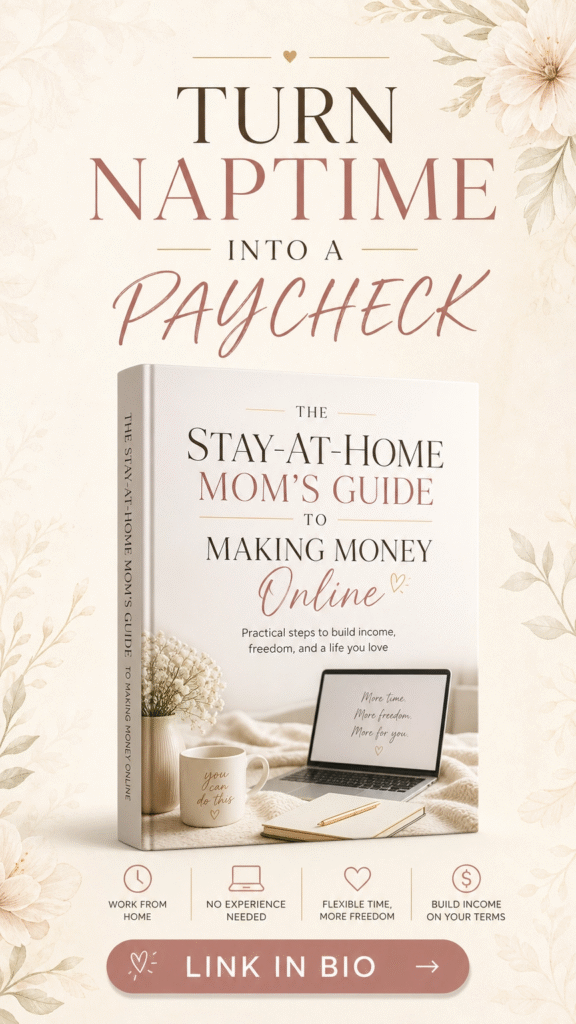
📗 The Stay-At-Home Mom’s Guide to Making Money Online covers all 12 income methods in specific, step-by-step detail — with exact platforms, tools, startup instructions, and a 30-day action plan designed for 30-minute work windows. No prior experience required. No startup costs for beginners.
Rated 4.9/5 by over 2,400 moms. Currently $27 (regular $47) with a 30-day money-back guarantee.
How to Hold Both: Financial Mastery and an Income of Your Own
The most powerful shift happens when both sides of the equation are working together.
When you understand your family’s finances deeply — the budget, the debt payoff plan, the retirement accounts — the money you earn doesn’t disappear into the household blur. It has a destination. The $300 from your first digital product sales goes into your Spousal Roth IRA. The $500/month from your virtual assistant clients funds the emergency fund that means car repairs are no longer a crisis.
When you have your own income, even a modest one, the budget stops feeling like restriction and starts feeling like strategy. You’re not just managing what comes in — you’re actively building something.

The two skills reinforce each other in ways that are hard to explain until you’ve experienced it. Financial literacy gives your income meaning and direction. Independent income gives your financial knowledge real stakes.
Together, they create something specific: the feeling of being genuinely in charge of your financial life — not dependent on circumstances, not waiting for something to change, but making decisions that compound into a future you designed.
What the Modern Stay-At-Home Mom Career Actually Looks Like
It doesn’t look like a corner office. It doesn’t look like a commute or a title or a performance review.
It looks like a mom who knows her family’s net worth to the dollar and has a plan to increase it. It looks like a Spousal Roth IRA that’s been maxed out two years running. It looks like an Etsy shop that runs in the background and a virtual assistant client who sends work every week. It looks like monthly money meetings with her spouse where they’re genuinely on the same team.
It looks like financial confidence that didn’t require sacrificing the reason she chose to be home.

The career isn’t gone. It just got redefined — on her terms, around her life, in a way that the previous generation of stay-at-home moms didn’t have access to.
You have access to it now. The tools exist. The roadmaps exist. The only thing left is to start.
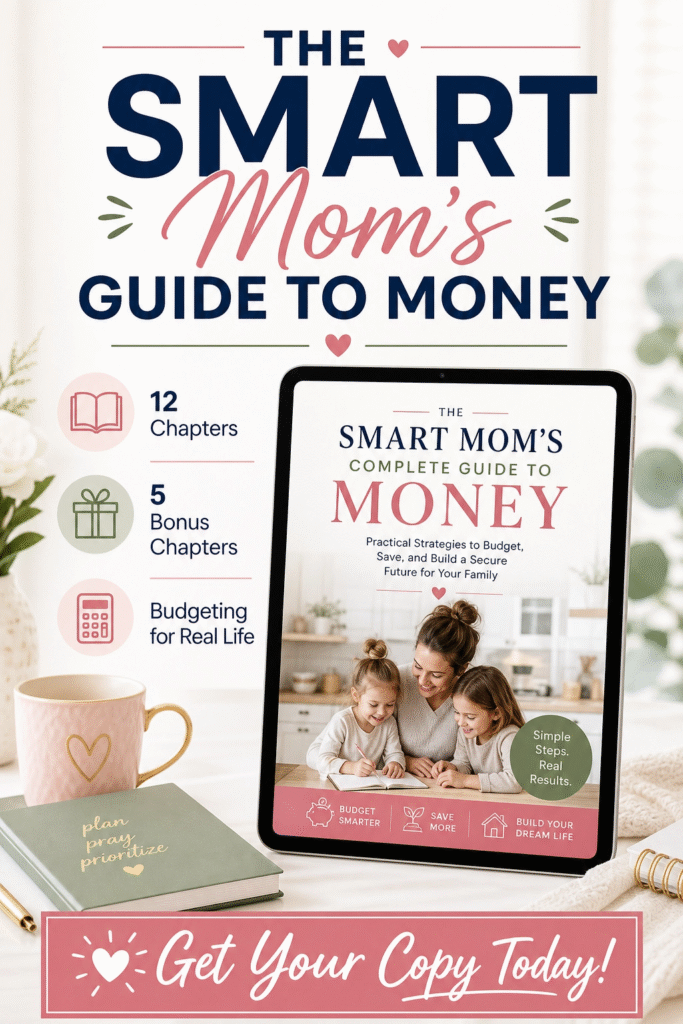
📘 The Smart Mom’s Complete Guide to Money is the complete personal finance framework for single-income families — 12 chapters covering budgeting, debt elimination, the Spousal Roth IRA, investing basics, insurance, retirement planning, raising money-smart kids, and building a financial legacy. Includes a full toolkit: budget template, debt payoff planner, net worth tracker, and 90-day action plan.
4.9/5 stars from 1,800+ families. $27 with a 30-day money-back guarantee.
Your Next Step (Pick Just One)
The gap between reading about financial empowerment and actually having it is one decision — the first one.
Here’s a short list. Pick the one that feels most urgent and do it this week:
- Open a high-yield savings account in your name if you don’t have one (most take under 10 minutes, no minimum balance)
- Write down every debt — creditor, balance, interest rate, minimum payment — and calculate your debt-free date using either the avalanche or snowball method
- Google “Spousal Roth IRA” and look up this year’s contribution limits. Then open one.
- Make a list of 5–10 skills you have that other people pay for — and spend 30 minutes looking at what those skills earn on Upwork or Etsy
- Choose one income method and commit to 30 days before evaluating

You don’t need to do all of them at once. You need to do one of them this week.
The new stay-at-home mom career isn’t waiting for permission or the perfect moment. It’s already available to you — right now, from exactly where you are.
This post contains affiliate links. We may earn a small commission at no extra cost to you. We only recommend resources we’ve genuinely reviewed and believe in.
About the Author