You know the feeling. You finish a self-help book buzzing with possibility, you make a list, you set an alarm for 6am, you’re ready — and then three weeks later you’re back where you started, with one more sticky note on your mirror and zero actual change. The book was good. The ideas were real. You just couldn’t seem to close the gap between knowing and becoming.
That’s not a discipline problem. It’s a design problem. And it’s exactly what Glow Up Your Life by LadyBossIncome is built to solve.
I went into this one with my guard up — “glow up” is the kind of phrase that gets slapped on everything from mascara to $1,000 life coaching programs with equally thin results. But 70 pages later, I have a full chapter-by-chapter breakdown, an honest take on what works and what doesn’t, and a genuine answer to the only question that matters: is it worth $57?
What This Book Actually Is (And Isn’t)
Let’s set expectations clearly, because the title sells a feeling and the book delivers something more useful: a system.
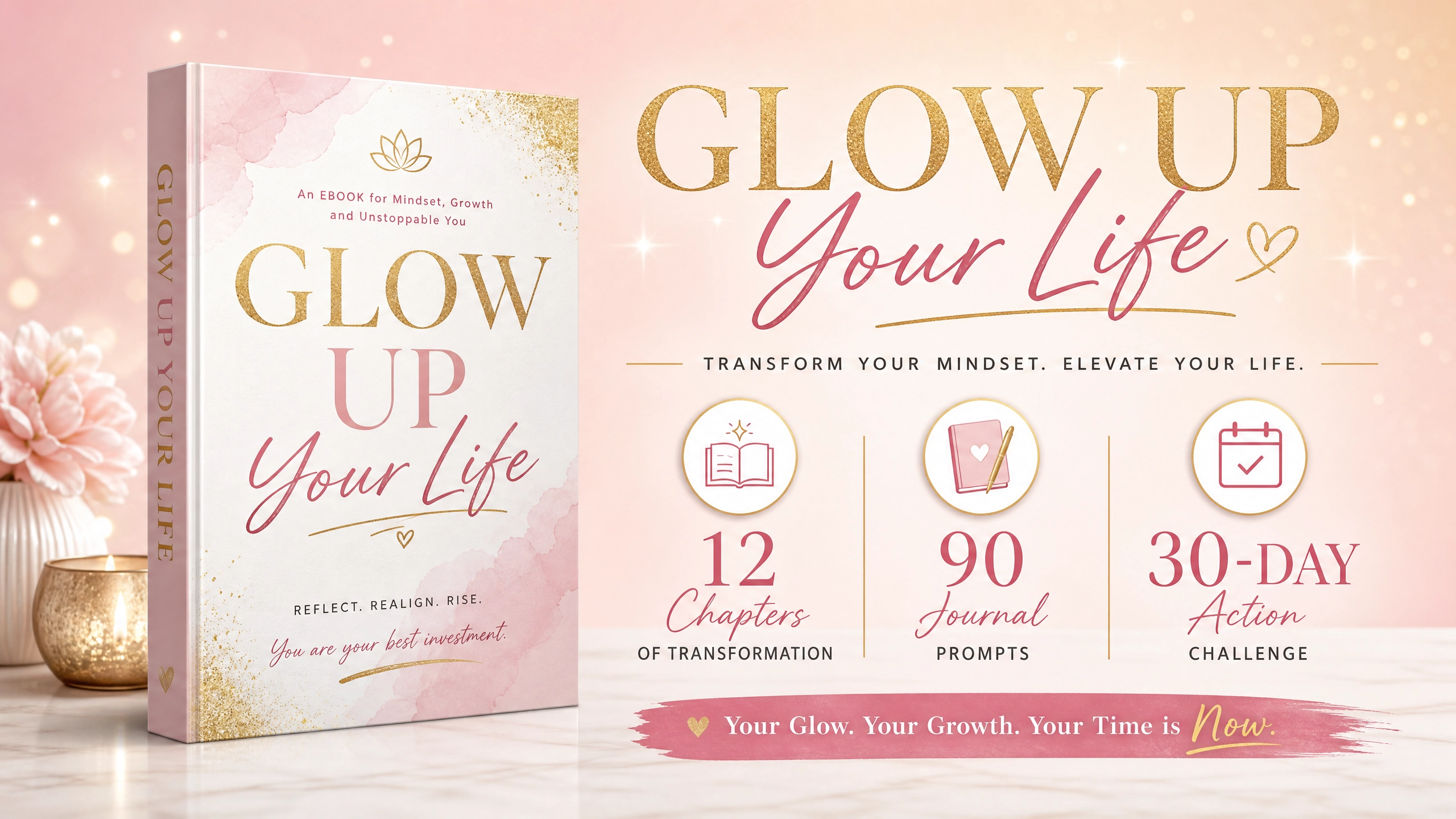
Glow Up Your Life is a 70-page PDF ebook covering 12 core transformation areas — identity, habits, morning routines, self-care, confidence, mindset, relationships, finances, productivity, physical wellness, digital wellness, and vision — plus three bonus chapters and four appendices. It’s described as “science-backed,” and it earns that label: the references to habit research, the cortisol awakening response, fixed vs. growth mindset frameworks, and the 80/20 principle all feel grounded rather than buzzword-y.
But here’s what makes it genuinely different from most self-help books: it starts with identity, not behavior. The first chapter isn’t “wake up earlier” or “drink more water.” It’s “change who you believe you are, and everything else follows.” That sequencing is intentional — and it’s the reason the rest of the book actually lands.
Who This Book Is Written For
The reader the author has in mind is specific — and she’s probably you if this sentence hits home: you know who you want to become, you just can’t seem to close the gap.
You’ve tried habit apps. You’ve set intentions on New Year’s Eve. You’ve watched the morning routine videos. You’ve had streaks and then lost them. You’re not lazy — you’re just working without a system that actually accounts for how human brains work.
This book is genuinely for you if:
- You want a holistic transformation, not just one area (fitness, money, relationships all show up here)
- You’ve read self-help before and felt inspired but ungrounded — good ideas without a clear “do this next”
- You’re at a turning point — new chapter of life, recovery from burnout, post-breakup reset, or just a quiet feeling that things need to change
- You have 30 minutes a day and want to use it with intention
You can probably skip it if:
- You want highly specialized deep dives (a full book on money, or a full book on habits — this is comprehensive, not exhaustive)
- You’re already deep in personal development and have a working system you’re happy with
- You’re looking for a quick motivational read with no real implementation
Chapter by Chapter: What’s Actually Inside
The book moves through a clear arc: who you are → how you operate daily → how you relate to others and money → what you’re building toward. The sequence isn’t arbitrary — each chapter assumes the ones before it.
Chapter 1: Who You Are Becoming — The One That Changes Everything
Multiple readers say this chapter made them cry. I understand it. The “I am” inventory exercise — writing out every identity statement you’ve been carrying, then examining which ones actually serve you — is the kind of thing that takes 20 minutes on paper and months to fully metabolize.
The core argument: identity drives behavior, not the other way around. You don’t build discipline and then become a disciplined person. You decide you’re a disciplined person, and then the behaviors follow with dramatically less friction. Every habit attempt that failed wasn’t a willpower failure — it was an identity mismatch. You were trying to act like someone you didn’t yet believe you were.
This reframe alone is worth the price of the book.
Chapter 2: The Art of Atomic Habits — Practical and Grounded
This is the habits chapter, and it’s clearly influenced by the research-backed frameworks most readers will recognize from the broader self-help canon. The Four Laws of habit change, habit stacking, morning and evening stacks — it’s all here, applied specifically to a glow up context rather than presented in the abstract.
The two-day rule — never miss the same habit twice in a row — is the practical gem of this chapter. Streaks are overrated. What actually builds a habit is what you do after you miss, not how long you go without missing.
Chapter 3: The Glow Up Morning Routine — Actually Useful, Not Aspirational
Morning routine content is everywhere, and 90% of it is aspirational fantasy designed for people with no children, no commute, and a sunrise-facing bedroom in Malibu.
This chapter is different because it starts with the science (the cortisol awakening response — the natural alertness spike in the first 30–45 minutes after waking — and why protecting it matters) before it gets prescriptive. Then it does something rare: it asks you to design your signature routine based on your life, not a template borrowed from a YouTube creator.
The framework: anchor habits (non-negotiables that take under 10 minutes) + optional stack (add when time allows). It’s the kind of design that actually survives a Tuesday when everything goes sideways.
Chapter 4: Radical Self-Care — Beyond the Hashtag
“Radical self-care” could so easily be a list of bath products and meditation apps. It isn’t. The four pillars here — physical, emotional, mental, and spiritual self-care — are treated with genuine depth, and the section on sleep as the most underrated glow up tool is a quiet gut-punch for anyone who’s been optimizing everything except the most fundamental recovery system she has.
The reframe that hit hardest: your body is an ally, not a project. Not something to fix, shrink, or override — a collaborator in the version of your life you’re trying to build.
Chapters 5–6: Confidence and Mindset — The Inner Work
The confidence chapter introduces the confidence dossier — a running document of evidence for your own capability, built over time — which is a more practical tool than most confidence-building advice I’ve encountered. Confidence isn’t performed. It’s accumulated through small, documented proof.
The mindset chapter tackles the inner critic with specificity rather than positivity-poster energy. The self-compassion framework here doesn’t ask you to feel good about yourself — it asks you to treat yourself with the same reasonable kindness you’d extend to anyone you love. That’s a much more accessible starting point.
Chapter 7: Relationships — The One Nobody Talks About Enough
The radiators vs. drains framework — people who add energy to your life vs. people who consistently deplete it — is simple, but the relationship audit exercise that goes with it isn’t comfortable. It asks you to look clearly at who’s in your life and what each relationship is actually costing or giving you.
The section on romantic relationships during a personal transformation is handled with nuance: growth can be destabilizing for relationships, and the book doesn’t pretend otherwise. It’s an honest chapter.
Chapter 8: Financial Glow Up — Surprisingly One of the Best
I didn’t expect the money chapter to be as strong as it is. The approach — uncover your money story before you try to change your money behaviors — mirrors the identity-first approach from Chapter 1, applied to finances. Most budgeting advice skips this step and then wonders why behavior change doesn’t stick.
The glow up money system is three-part: know your numbers, pay yourself first, grow your income. It’s not comprehensive personal finance — but it’s the right starting framework for someone who’s been avoiding the conversation entirely. Reader Keisha saved $1,200 in three months following the system. That kind of outcome from a chapter in a $57 ebook is hard to argue with.
Chapters 9–12: Productivity, Physical Wellness, Digital Detox, and Vision
The productivity chapter’s reframe from time management to energy management is the most underrated shift in the book. You don’t have a time problem. You have an energy problem — and scheduling more things into depleted hours doesn’t fix it.
The digital wellness chapter (Chapter 11) is where the book gets almost uncomfortably accurate about how much the attention economy is quietly costing you. Phone-free zones, intentional app design, the real cost of default scrolling — this chapter is a useful mirror.
Chapter 12 closes with the 10-year vivid vision exercise and a month-by-month 12-month blueprint. It’s not a vague visualization exercise — it’s a structured planning tool that connects to everything that came before it. By the time you reach it, you have enough identity and habit foundation that the vision actually feels buildable.
The Bonuses: Genuinely Useful
The 30-Day Glow Up Challenge is designed to make starting frictionless — one small action per day, each one building evidence for your new identity. The 90 Journal Prompts are the standout here. Not “what are you grateful for?” questions — deep, specific prompts organized across identity, goals, and life design that surface the beliefs and patterns actually shaping your direction. The sample prompts alone (write your future self a letter; what old “I am” story was never actually yours?) are the kind of questions that stop you mid-scroll and make you want to sit with a notebook.

What I Loved
Identity first, always. The sequencing of this book is its superpower. It doesn’t ask you to do better before it helps you believe differently. That order matters more than most self-help books acknowledge.
Short chapters with mandatory action steps. Every chapter ends with one concrete action completable in under 30 minutes. The design respects that you’re busy and removes the “I’ll implement this later” escape hatch.
The tone is warm without being saccharine. It reads like a smart friend who’s done the work and wants you to catch up — not a life coach selling you on how broken you currently are.
The journal prompts are genuinely deep. 90 prompts across an entire season of transformation is a resource that would stand alone as a product.
What Could Be Better
It covers a lot of ground. Twelve transformation areas in 70 pages means some topics get four pages when they could sustain a full book. The financial chapter, the relationships chapter — both could easily expand. Think of this as a blueprint, not a deep-dive on any single area.
No community or accountability structure. The 30-day challenge is most effective when you have somewhere to report in. A reader community would make the implementation dramatically more powerful.
The $57 price point is a slight jump compared to similar ebooks — though the 30-day money-back guarantee makes it genuinely risk-free to try.
The Verdict: Is Glow Up Your Life Worth $57?
Yes — especially if you’ve bought and abandoned self-help books before.
The reason most self-help fails isn’t the ideas. It’s the missing architecture connecting inspiration to daily behavior. Glow Up Your Life provides that architecture — from identity through habits through vision — in a format you can actually implement in the margins of a real life.
If you read it actively (not just passively), do the chapter action steps as you go, and actually use the 30-day challenge and journal prompts, this book can do something most self-help books can’t: produce evidence that you’re changing. And evidence is what turns a goal into an identity.
→ Start Your Glow Up — $57 · Instant PDF download · 30-day money-back guarantee
Make the Morning Ritual Feel Like Yours
If Chapter 3 on morning routines resonates with you — and it probably will — there’s something to be said for making that ritual feel intentional in every detail, right down to what you’re holding while you journal or read.
For the mom, the entrepreneur, the woman building something new over her first quiet hour of the day: this Mom is My Home Watercolor Cottage Mug from omniinspo has cottagecore garden energy that turns any desk or kitchen table into a little sanctuary. The kind of detail that signals: this time is mine.
→ Shop it: Mom is My Home Watercolor Cottage Mug — $19.99
And if you’re gifting this book to the woman in your life who’s been quietly ready for a reset — pair it with something that says you see her. The Graceful Like a Mother Botanical Mug from omniinspo does exactly that — an elegant dried flower design that feels intentional rather than generic, for the woman who brings that same care to everything she does.
→ Shop it: Graceful Like a Mother Botanical Mug — $19.99
This post contains affiliate links. We may earn a small commission at no extra cost to you.
About the Author