There’s a version of you that already knows how to use Claude. She writes killer client proposals in 20 minutes. She has a prompt pack selling on Gumroad. She’s building a one-person agency that earns while she sleeps. She’s not smarter than you — she just found the right system first.
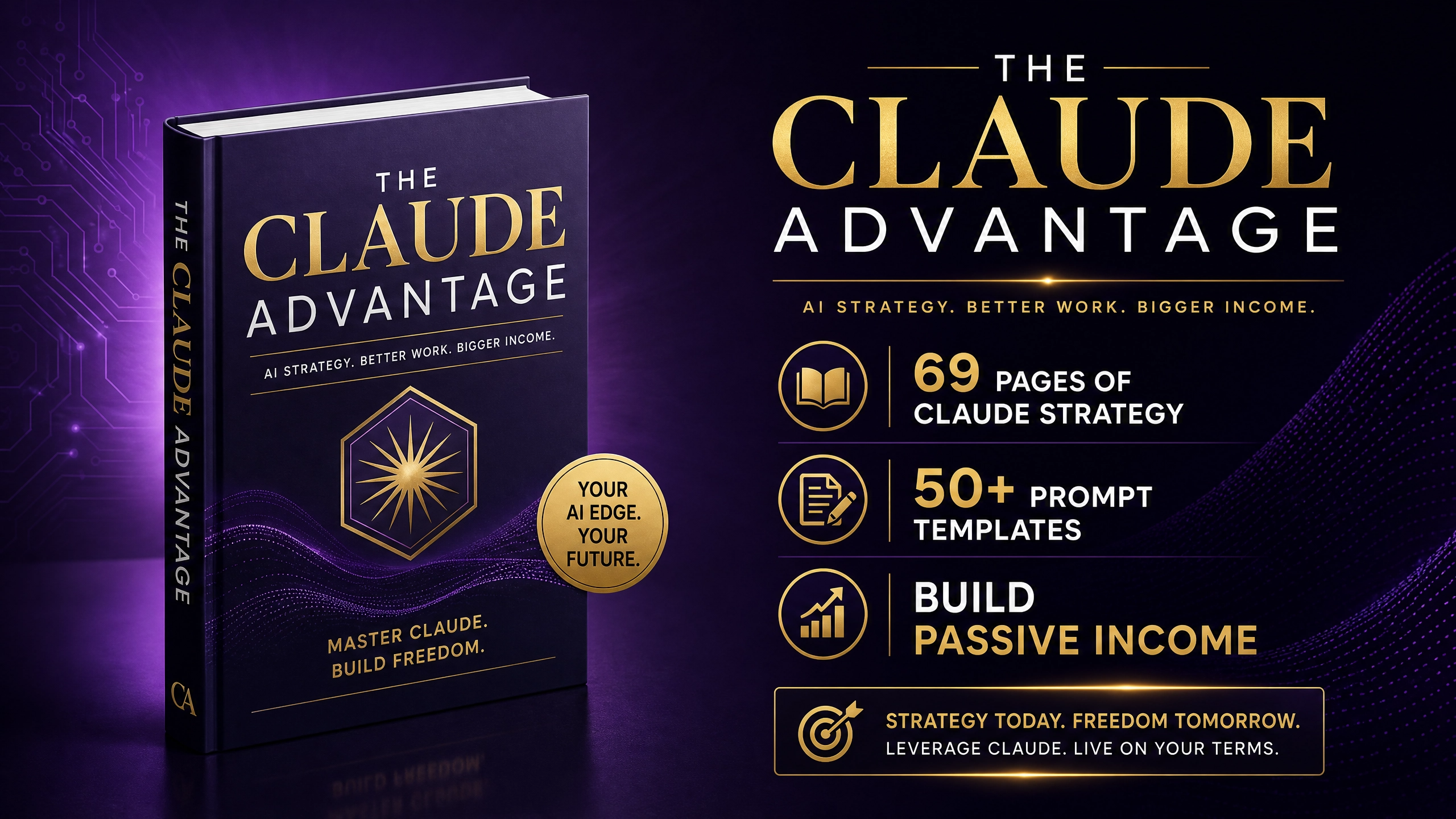
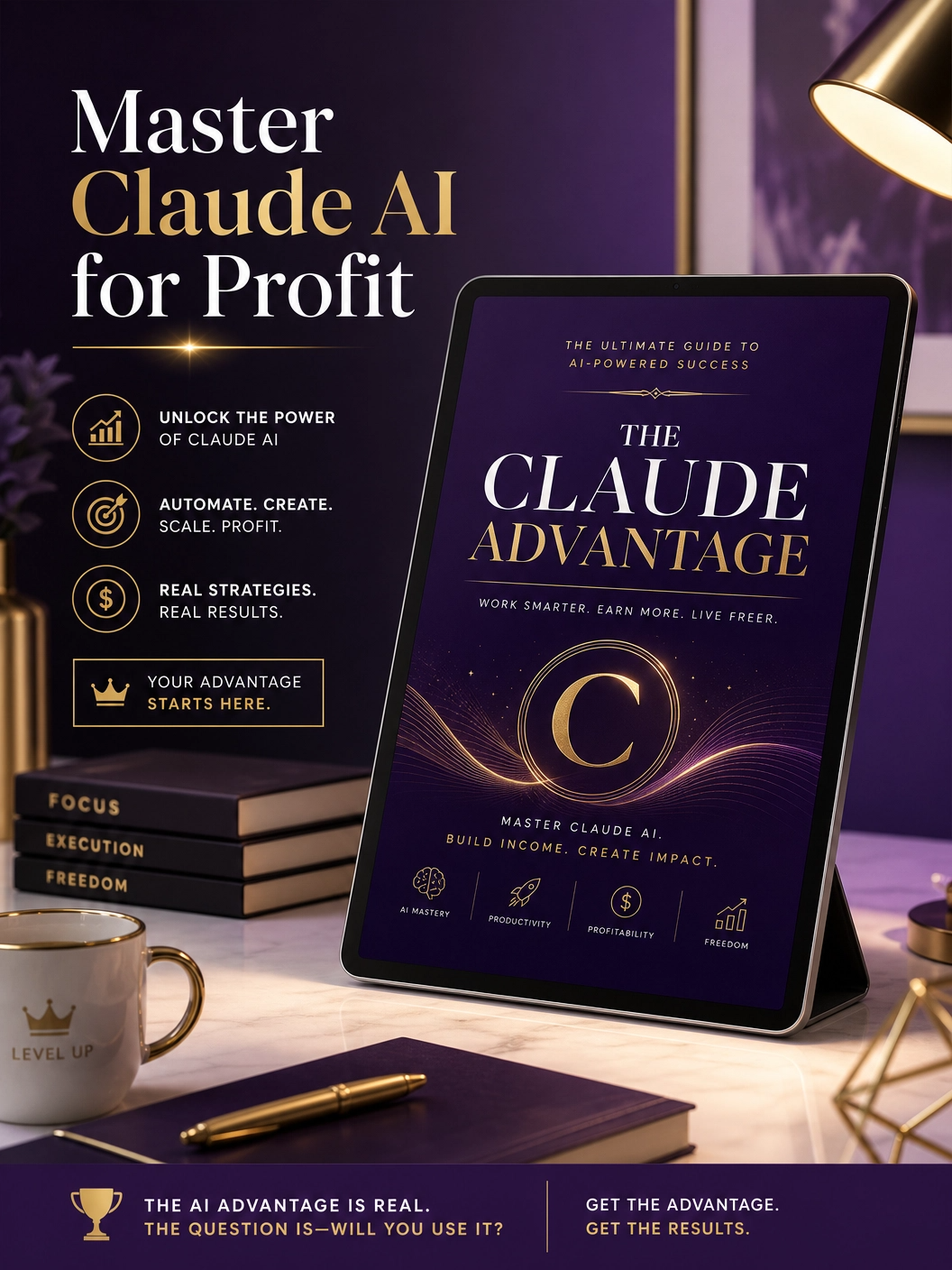
The Claude Advantage is trying to be that system. And after reading every page of this 69-page ebook from LadyBossIncome, I have a lot of thoughts.
Here’s my full honest review — what’s actually inside, who it’s genuinely for, what surprised me, and whether it’s worth your $47.
That Makes This Different From Every Other AI Business Ebook
The AI business ebook space is crowded right now. So before I break down the content, I want to address the obvious question: why Claude specifically?
Most AI business books are tool-agnostic by design — they cover “AI” broadly so they stay relevant longer. The Claude Advantage does the opposite. It goes all-in on Claude: the Projects feature, the 200K context window, Artifacts, the Claude API, and the specific workflows that make Claude the strongest tool for most business use cases.
That specificity is either its biggest strength or a dealbreaker, depending on what you’re looking for. If you’re a ChatGPT loyalist, there’s an appendix comparing Claude to ChatGPT, Gemini, and Copilot — and the book makes a compelling case for why Claude pulls ahead for business writing, long-form projects, and client work. But the focus is Claude, start to finish.
For anyone already using Claude — or curious about switching — that focus is a feature, not a bug.
Who This Book Is Really For
The sales page says this is “built for women who want Claude to earn for them.” That’s the core reader. But let me get more specific, because the book has layers.
You’ll get enormous value if you’re:
- A freelancer — writer, strategist, VA, marketer — who uses Claude occasionally but hasn’t systemized it
- Someone who has been meaning to create a digital product (prompt pack, template bundle, mini-course) but hasn’t started
- A coach or consultant who wants to charge more and deliver better without working more hours
- Curious about building with the Claude API but terrified of the “technical” side
- Starting from zero income and wanting a clear, sequenced path
You might find it a bit surface-level if you:
- Already run a systematized AI business at $10K+/month
- Want deep technical documentation on the Claude API (this is strategic, not engineering)
- Prefer long-form courses with video and community support
The sweet spot? Someone who’s been using Claude for emails and occasional drafts but has a nagging feeling she’s leaving a lot on the table. She’s right. And this book addresses that directly.
Inside the Book: Chapter by Chapter
The structure is tight — 12 core chapters that build sequentially, 3 bonus chapters, and 4 appendices. The author’s stated goal: by Chapter 12, you have a complete, working income system. Not a collection of tactics. A system. Let’s see how well it delivers.
Chapter 1: Why Claude Is Different (And Why It Matters for Business)
This is the “make your case” chapter, and it earns its place. It covers the Projects feature — Claude’s ability to remember context across sessions and maintain a consistent “persona” for your business — as the core differentiator from other AI tools. The concept of the Director Model introduced here reframes how you think about working with Claude: you’re not typing prompts, you’re directing an extremely capable team member who needs clear briefs.
It’s a mindset shift that makes everything that follows click faster.
Chapter 2: Prompting for Profit — The Complete Playbook
Multiple readers cite this as the chapter that changed everything for them — and I understand why. The RACE framework (Role, Action, Context, Expectation) is one of those deceptively simple structures that immediately makes your prompts better. The 20 advanced prompting techniques that follow are genuinely useful, not padded. If you’ve ever gotten mediocre output from Claude and couldn’t figure out why, this chapter diagnoses the problem.
The author’s claim that “this chapter alone is worth the price of the book” sounds like marketing copy until you read it. Then it just sounds accurate.
Chapters 3–8: The Six Income Models
This is the core of the book, and it’s where the real value lives. Each chapter tackles one business model with the same reliable structure: here’s what it is, here’s the Claude workflow, here’s how to price it, here’s your action step.
A few that stand out:
Chapter 3 (Digital Products with Claude) walks you through building a prompt pack, template bundle, or mini-course from concept to Gumroad listing — in a weekend. Not someday. This weekend. The specificity is refreshing. It doesn’t just tell you that digital products are a great passive income stream; it tells you exactly how to build one with Claude doing most of the heavy lifting.
Chapter 6 (Building a Claude-Powered Agency) is the most ambitious chapter in the book. The model it describes — one person, Claude, documented workflows, retainer clients — targets $15K–$50K/month. That range feels aspirational until you see the math laid out. The key insight: you’re not selling your time anymore. You’re selling a documented, repeatable system that happens to run on Claude. That’s a fundamentally different business.
Chapter 7 (Building With the Claude API for Non-Developers) is the chapter I expected to skim and ended up reading twice. Using Make.com and Zapier as no-code bridges to the Claude API, the author walks through building niche tools that can generate recurring revenue — without writing a single line of code. The example: $49/month × 200 users = $9,800 MRR. From a tool built in an afternoon. Whether or not those numbers reflect your reality, the model is real, and the chapter makes it accessible.
Chapter 9 (Passive Income Stacks) covers the architecture of a $10K/month passive income business across four streams: digital product library, paid newsletter tier, evergreen course funnel, and affiliate revenue. The key word in the title is stacks — these streams are designed to support and compound each other, not exist in isolation. It’s the most strategic chapter in the book.
Chapters 10–12: Advanced Techniques, Consulting, and the 90-Day Plan
Chapter 10 goes deeper on Claude-specific power features — the 200K context window as a business tool, advanced Projects usage, API automations for non-developers. If Chapter 2 taught you to drive, Chapter 10 teaches you the highway.
Chapter 11 on consulting and coaching is shorter than I’d like, but it covers the key insight: Claude doesn’t just help you deliver coaching — it helps you prepare at a level most consultants never reach, which justifies charging significantly more.
Chapter 12 — the 90-day launch plan — is week-by-week and specific enough to actually follow. It’s not “here’s a general framework.” It’s “in week two, do this. In week three, do this.” Multiple readers in the testimonials reference this chapter as the thing that made everything real.
The Bonuses: Better Than Expected
The Claude Prompt Vault (50 tested prompts organized by business function) is the kind of resource that would feel like a standalone product. These aren’t generic prompts — they’re business-specific templates for writing, strategy, product creation, client work, and research.
The 10 Claude Income Blueprints take ten specific business models and give you target income range, time to first revenue, required conditions, and the exact Claude workflow for each. It’s a mini-book inside a book.
The 60-Minute Setup Checklist is for anyone who reads the whole thing and then freezes at implementation. It’s designed to get you fully operational — account setup, Project templates, starter prompt library, first revenue-generating output — in a single focused hour.
What I Loved
The specificity never lets up. This book gives you income ranges, timelines, frameworks, and step-by-step workflows throughout. It trusts the reader to handle real information rather than softening everything into vague inspiration.
It treats Claude as a serious business tool. Not a novelty, not a shortcut, not a way to cheat at work — but a genuine leverage multiplier that changes what one person can build. The framing matters.
The 90-day plan is genuinely actionable. Week by week, milestone by milestone. Not “work toward your goal.” Actual directions.
The Appendix A comparison (Claude vs. ChatGPT vs. Gemini) is one of the most honest AI tool comparisons I’ve seen in a product like this. It doesn’t just declare Claude the winner — it shows where Claude leads and where others hold their own.
What Could Be Better
Some chapters could sustain an entire book. The digital products chapter, the agency chapter, the passive income chapter — each one is worth a deeper dive that 69 pages simply can’t provide. Think of this as the map, not the full terrain.
No community or ongoing support. You’re buying a PDF. If you hit a wall implementing the Claude API chapter or your first prompt pack doesn’t sell, there’s no built-in place to ask for help. A reader community would transform this from a great book into a great program.
The testimonial results are strong — almost too strong. Melissa launched a prompt pack in 11 days and made $840 in two weeks. Priya is up $2,800 MRR at month three. These may be completely accurate, but I’d love to see the book acknowledge that results vary widely based on execution, existing audience, and chosen model.
The Verdict: Should You Buy The Claude Advantage?
If you’re using Claude — even occasionally — and you want to understand what’s actually possible with it from a business standpoint, yes. This is the most Claude-specific, strategically grounded resource I’ve come across at this price point.
The RACE prompting framework alone will immediately improve your output quality. The income model breakdowns give you a real decision framework for where to focus. And the 90-day plan gives you permission to stop planning and start doing.
What this book requires from you: action. Not a lot of time, not a lot of money beyond the $47 — but actual follow-through on the weekly steps. Readers who treat it as a reference to skim will get less than readers who treat Chapter 12 as a literal weekly checklist.
The window to build something real with AI tools is still open. This book is a solid guide for stepping through it.
→ Get The Claude Advantage — $47 · Instant PDF download · 30-day money-back guarantee

The Small Ritual That Makes It All Land
Here’s something nobody talks about in the “build your AI business” conversation: where you do the work matters. The solopreneurs who actually follow through on systems like this — they have a setup that signals to their brain: this is focus time. This is the work that changes things.
For me, that’s a dedicated mug, a clear desk, and a blocked hour with no notifications. If you’re building something new — even incrementally, even 45 minutes at a time — it helps to make that time feel intentional.
This Wild Beautiful Mom Floral Wreath Mug from omniinspo has been part of my morning work ritual lately. The boho watercolor design is the kind of thing that makes a plain desk feel a little more like yours — which sounds small until you realize how much the environment shapes the effort.
→ Shop it: Wild Beautiful Mom Floral Wreath Mug — $19.99
This post contains affiliate links. We may earn a small commission at no extra cost to you.
About the Author