Financial Independence for Stay-At-Home Moms — Full Guide
Nobody talks about the quiet part of being a stay-at-home mom.
Not the beautiful parts — the slow mornings, the front-row seat to every milestone, the choice you made deliberately and would make again. Those parts get talked about plenty. The quiet part is the money anxiety that lives just underneath all of it. The way a single unexpected expense can spiral into a week of stress. The way you notice, more than you’d admit, that all the money moves through accounts that aren’t yours. The way you Googled “how to make money from home” at 11pm and closed twenty tabs without a clear answer.
Financial independence for stay-at-home moms isn’t a fantasy or a contradiction. It’s a plan — one that covers both sides of the equation: managing the money your family already has, and building income that’s genuinely yours.
This is that plan.
Why “Just Budget Better” Advice Always Falls Short
Here’s the thing about most financial advice aimed at moms: it assumes the problem is spending. Cut the lattes, batch the meals, shop the sales — as if the gap between anxiety and stability is just a matter of discipline.
It’s not.
For most single-income families, the gap is structural. One income doing the work of two lives. Debt that compounds quietly while minimum payments go out every month. Retirement accounts that belong to one spouse while the other — the one running the household, doing the invisible labor — has nothing in her own name.

Budgeting is part of the answer. But it’s one chapter in a much longer book, not the whole story.
Real financial independence for stay-at-home moms has two parts that have to work together:
Part 1: Get control of the money you have. Budget that actually holds. Debt eliminated on a real timeline. Emergency fund that stops every car repair from being a crisis. Retirement account in your name.
Part 2: Build income that’s yours. Not “help with household expenses.” Your money, earned in your time, from your skills — that you control.
Miss either part and you’re only halfway there. Do both, and the whole picture changes.
Part 1: Taking Complete Control of Your Family’s Finances
Start With Your Money Story (Before the Spreadsheets)
Every financial decision you’ve ever made was shaped by something you learned before you were old enough to question it. The way your parents talked (or didn’t talk) about money. What you absorbed about what women are supposed to handle or leave to someone else. The beliefs running quietly in the background: I’m not good at math. We just don’t have money people. It’s selfish to want financial independence within a marriage.
None of those stories are true. But they’ll keep running the show until you consciously examine them.
This is why the best personal finance framework for moms doesn’t start with a budget template — it starts with a mindset assessment. Understanding what’s actually driving your financial patterns is what makes every other strategy stick.
Know Your Numbers Without Judgment
You can’t navigate without a map. That means knowing your net worth (assets minus liabilities — don’t panic, it’s just a number), your monthly cash flow, and a clear picture of every debt: balance, interest rate, minimum payment.
Most people avoid this step because it feels like a verdict. It isn’t. It’s just information — and information is the only thing that gives you options.
The Budget That Actually Survives Real Mom Life
Three approaches, each suited to a different personality:
Zero-based budgeting: Every dollar gets assigned a job before the month begins. Income minus expenses equals zero — not because you’ve spent everything, but because every dollar has a destination (including savings). Families who switch to this approach typically find $150–$400/month in spending they didn’t know was leaking. Not by cutting joy. By stopping the unconscious.
The 50/30/20 rule: 50% needs, 30% wants, 20% savings and debt. A more flexible framework if rigid budgeting feels suffocating.
Sinking funds: A system for irregular expenses that are never actually surprises — Christmas, back-to-school, car maintenance, medical copays. You fund them monthly so they don’t derail everything when they arrive.
The best budget is the one you’ll use. The goal isn’t perfection — it’s consistency.

Eliminating Debt With an Actual End Date
Here’s the mindset shift that changes everything: debt doesn’t have to feel infinite. When you calculate your exact debt-free date — using either the avalanche method (highest interest rate first, mathematically optimal) or the snowball method (smallest balance first, psychologically powerful) — the weight lifts. You have a date. You can put it on the fridge. March 2027 feels different than “someday.”
The strategic pieces matter too: negotiating interest rates (yes, you can call and ask), balance transfer opportunities, which accounts to attack first. But the date is what makes it real.
The Financial Tools Stay-At-Home Moms Are Missing
This is the part that doesn’t appear in general personal finance content, because general personal finance content wasn’t written for you.
The Spousal Roth IRA is one of the most powerful and most overlooked financial tools available to stay-at-home moms. As long as your household has earned income, you can contribute up to $7,000 per year to a Roth IRA in your own name. Tax-free growth. Tax-free withdrawals in retirement. An account that belongs to you — not to the marriage, not to your spouse’s employer, to you. You can even make retroactive contributions for prior years if you didn’t know this existed.
Independent credit matters too. A credit card in your name, used and paid responsibly, builds a credit history that’s yours — regardless of what happens in your marriage.
Equal financial partnership means you understand every account, every investment, every insurance policy. Not because you don’t trust your spouse. Because you’re a full partner in the decisions that affect your family.
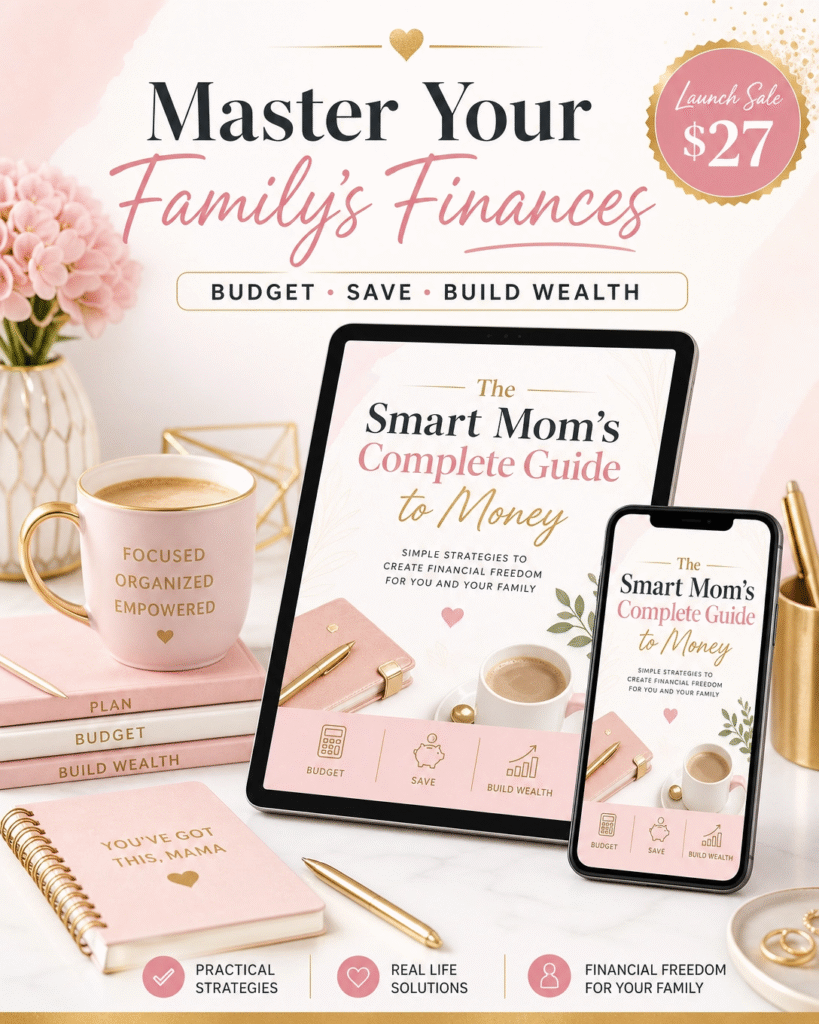
📘 The Smart Mom’s Complete Guide to Money covers all of this — the budgeting frameworks, debt elimination strategy, Spousal Roth IRA, retirement planning, and a complete financial toolkit including budget templates, a debt payoff planner, and a 90-day action plan. Written judgment-free, specifically for single-income families.
Part 2: Building Income That’s Genuinely Yours
Why “Going Back to Work” Isn’t the Only Answer
The conversation around financial independence for stay-at-home moms tends to jump straight to “get a job.” And for some moms, that’s the right answer. But for many — with childcare costs, inflexible school schedules, a child with special needs, or simply a deliberate choice to be home — a traditional job isn’t the goal.
The internet has made something genuinely possible that wasn’t available to previous generations: building real, sustainable income from home. Not passive-income fantasy schemes. Not “earn $5 clicking surveys.” Real income streams that fit around real mom life — including the kind where your work hours are 9pm–11pm and your “office” is the kitchen table.
The key is starting with the right method for where you are right now.
The Fastest Path to Your First Dollar Online
Virtual assistant work is where many moms start — and for good reason. Income can come within 1–3 weeks. You don’t need a portfolio, a website, or an established audience. You need skills you already have: managing schedules, writing emails, organizing information, social media, customer communication.
Clients on platforms like Upwork pay $25–$75/hour for these services. The barrier to entry is genuinely low. The learning curve is in finding clients and presenting yourself — both of which are learnable, specific skills, not mysterious arts.

Income Streams That Build Over Time
Digital products are the long-game favorite for a reason: create once, sell forever. Templates, printables, planners, workbooks, guides — things other people need that you can make using Canva (which is free). Sell on Etsy, Gumroad, or your own site. A well-optimized Etsy shop can generate passive income while your kids are at school, while you’re making dinner, while you sleep.
Affiliate marketing layers on top of whatever content you’re already creating. Recommend products you genuinely use, earn a commission when someone buys through your link. This is the easiest income stream to start today — you can sign up for programs and start sharing within hours. The income is modest at first, then compounds as your audience grows.
Blogging and content creation is the slow build that becomes the biggest thing. Build an audience that trusts you, then monetize through ads, affiliates, and your own products. Honest timeline: 6–12 months before meaningful income. But the asset you’re building — an audience, a platform, a brand — compounds in a way that very few other income streams do.
Print-on-demand lets you sell physical products (mugs, t-shirts, tote bags, throw pillows) without inventory, upfront cost, or fulfillment. You design, someone else prints and ships. Canva works for the designs. The startup cost is genuinely zero.
Online courses and coaching are for the slightly later stage — when you’ve built some credibility or audience — but they represent the highest earning potential per hour of any method here. You know things other people want to learn. That has value.
How to Choose Where to Start
The question isn’t which method is best. It’s which method fits your life right now.
- Need income within weeks? Start with virtual assistant work.
- Have 30–45 minutes a day and want something that compounds? Start with digital products on Etsy.
- Want to build something long-term? Start a blog or content platform alongside whichever fast-track method you choose.
- Have a skill or expertise people keep asking you about? That’s a coaching offer waiting to happen.
The biggest mistake is spending three months researching all the options instead of starting one. The perfect strategy that you don’t execute beats every imperfect one that you do.
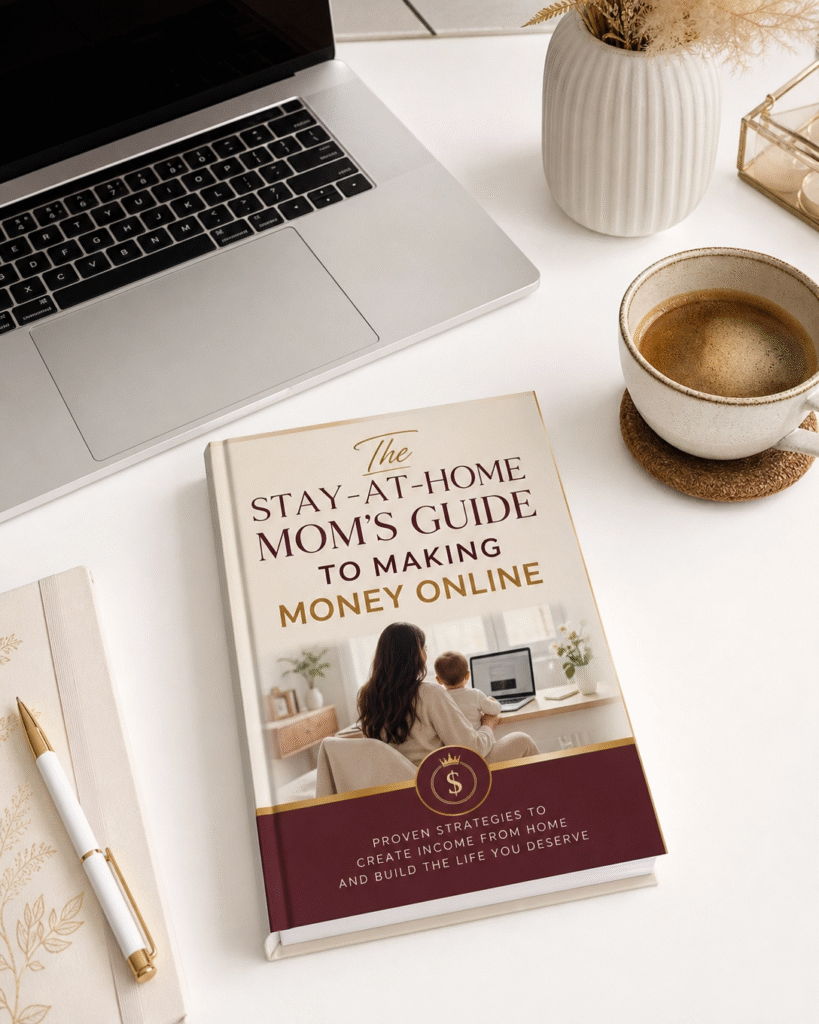
📗 The Stay-At-Home Mom’s Guide to Making Money Online covers all 12 income methods in detail — freelancing, digital products, affiliate marketing, virtual assistant work, blogging, print-on-demand, social media monetization, online courses, and more. Each chapter includes specific platforms, exact tools, step-by-step instructions, and a 30-day action plan to your first dollar.
How the Two Sides Work Together
Here’s what most financial advice misses: managing money and earning money are not separate conversations. They feed each other in ways that matter.
When you have a clear budget, the $300 you make from your first digital products sale doesn’t disappear into the household blur — it goes exactly where you decided: into the emergency fund, onto the debt, into your Spousal Roth IRA. Your earning has direction.
When you have income, the budget stops feeling like deprivation and starts feeling like a tool. You’re not just cutting — you’re also building.
Together, the two sides create something that neither achieves alone: genuine financial confidence. The kind where you know your family is protected, you have money in your own name, and you’re moving toward a future you helped build.

What to Do This Week (Not “Someday”)
The gap between reading about financial independence and actually having it is action — specifically, first actions that are small enough to do today.
This week, on the money side:
- Write down every debt: balance, interest rate, minimum payment
- Calculate your net worth (just the number — no judgment)
- Open a high-yield savings account if you don’t have one (most have no minimum, take 10 minutes)
- Look up Spousal Roth IRA contribution limits for this year

This week, on the income side:
- Make a list of 5–10 skills you have that other people pay for
- Browse Etsy for digital products in your area of knowledge — see what’s selling
- Create a free Upwork profile if VA work interests you
- Choose one income method and commit to learning it for 30 days before evaluating others
The point isn’t to do everything at once. The point is to do something — this week, not when the timing is better or the kids are older or you feel more ready.
The timing will never be perfect. The window to start is always right now.
The Bottom Line
Financial independence for stay-at-home moms isn’t a single step. It’s a combination of getting real about your family’s finances and building income that belongs to you — pursued simultaneously, with a clear plan for each.
You don’t need a finance background. You don’t need technical skills. You don’t need to go back to work full-time or hand your kids off to daycare to justify having your own money. You need a roadmap — one that was written for your actual life.
Two books do exactly that:
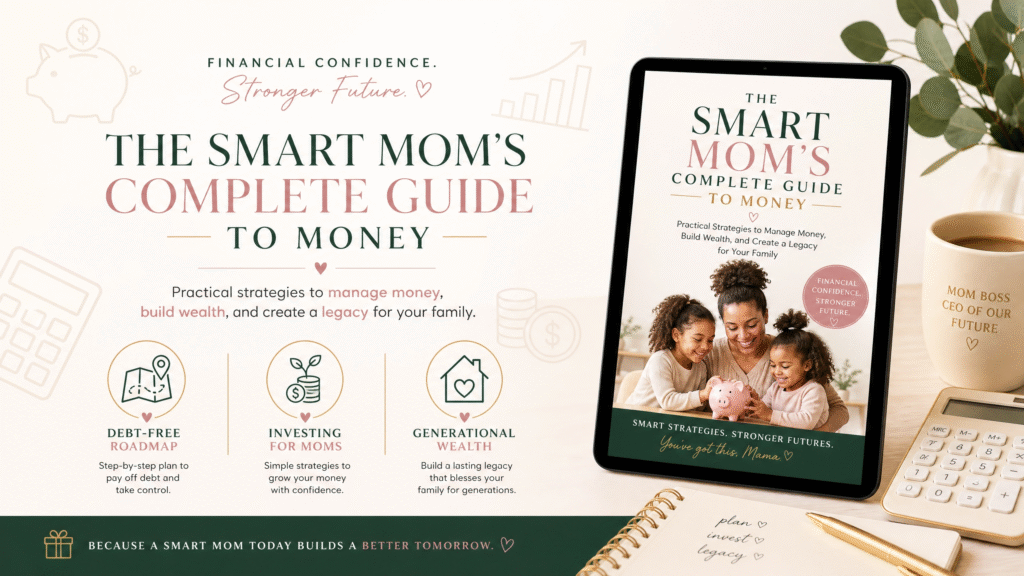
→ For the money side — budgeting, debt elimination, investing, retirement, financial power within your marriage:
The Smart Mom’s Complete Guide to Money — $27
→ For the income side — 12 methods to make money online, step-by-step, built for 30-minute work windows:
The Stay-At-Home Mom’s Guide to Making Money Online — $27
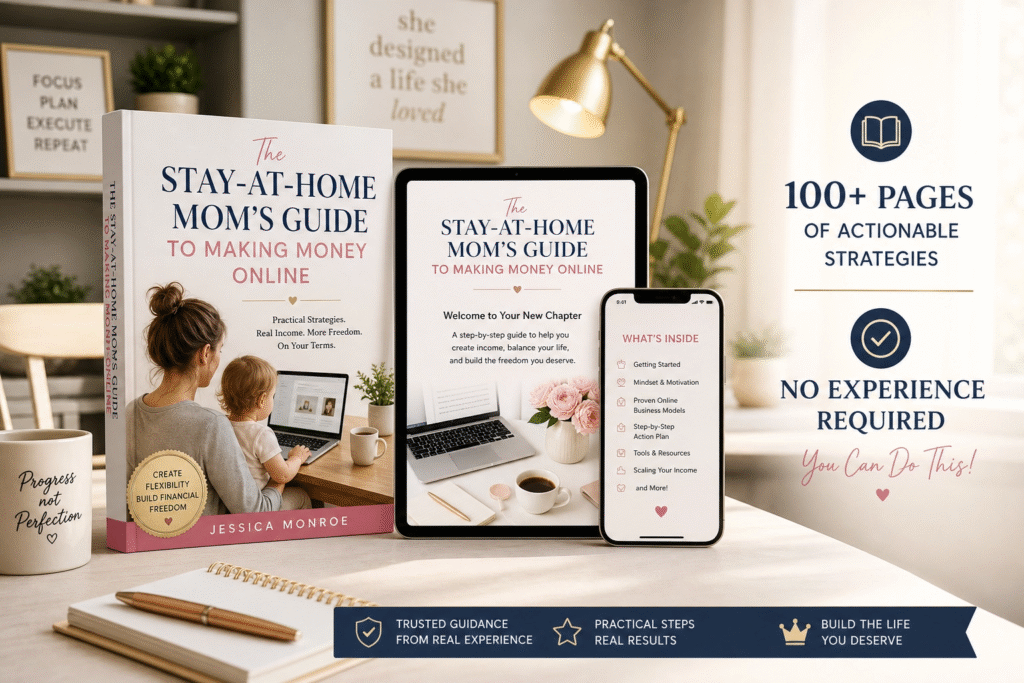
Both carry a 30-day money-back guarantee. Both deliver instantly. Both were written by someone who has been exactly where you are — and found a way through.
You’ve already done the hardest part. You’re paying attention. The rest is just the plan.
This post contains affiliate links. We may earn a small commission at no extra cost to you. We only recommend resources we’ve genuinely reviewed and believe in.
About the Author